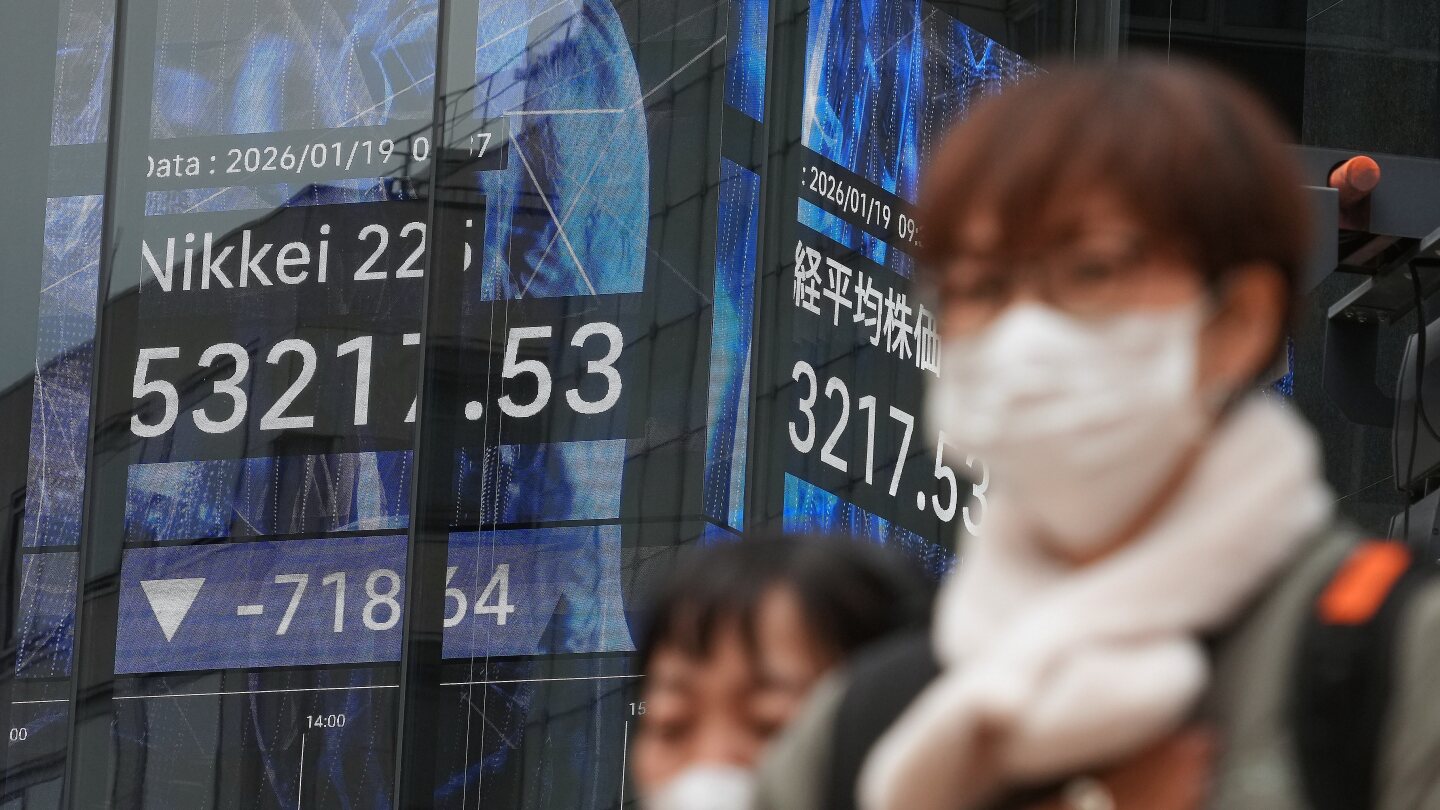
Financial markets across Asia experienced broad declines on Tuesday as investor sentiment deteriorated following geopolitical tensions and domestic political developments. The downward trend emerged during a quiet session for U.S. markets, which remained closed for the Martin Luther King Jr. Day holiday.
The Japanese market faced particular pressure as Prime Minister Sanae Takaichi’s announcement of a snap February 8th election triggered significant volatility in government bonds. Yields on Japan’s 40-year government bonds surged to a record 4%, while other long-term debt instruments reached multi-decade highs. This selloff reflected market concerns that Takaichi might leverage her strong approval ratings to implement increased government spending measures, potentially straining Japan’s national finances.
Meanwhile, transatlantic trade relations faced renewed strain after U.S. President Donald Trump threatened to impose 10% tariffs on imports from eight European nations—Denmark, Norway, Sweden, France, Germany, the United Kingdom, Netherlands, and Finland. The proposed tariffs, reportedly linked to European opposition regarding American control of Greenland, drew immediate criticism from affected countries who condemned the move as damaging to transatlantic relations.
Regional market performance varied with Tokyo’s Nikkei 225 declining 1.1% to 52,988.24, while China’s Shanghai Composite fell 0.3% to 4,101.62. Hong Kong’s Hang Seng edged down marginally to 26,552.57. South Korea’s Kospi bucked the trend with a 0.3% gain to 4,921.42, and Australia’s S&P/ASX 200 dropped 0.6% to 8,818.10.
European markets had set a negative tone on Monday, with Germany’s DAX losing 1.3% and France’s CAC 40 falling 1.9%. U.S. stock futures indicated continued weakness, with S&P 500 futures down 1% and Dow Jones Industrial Average futures declining 0.9% in early Tuesday trading.
Investors awaited key economic developments including upcoming corporate earnings reports and critical inflation data that could influence Federal Reserve policy decisions. The Fed’s next meeting in two weeks is expected to maintain current interest rates as policymakers balance slowing employment indicators against persistent inflation above their 2% target.