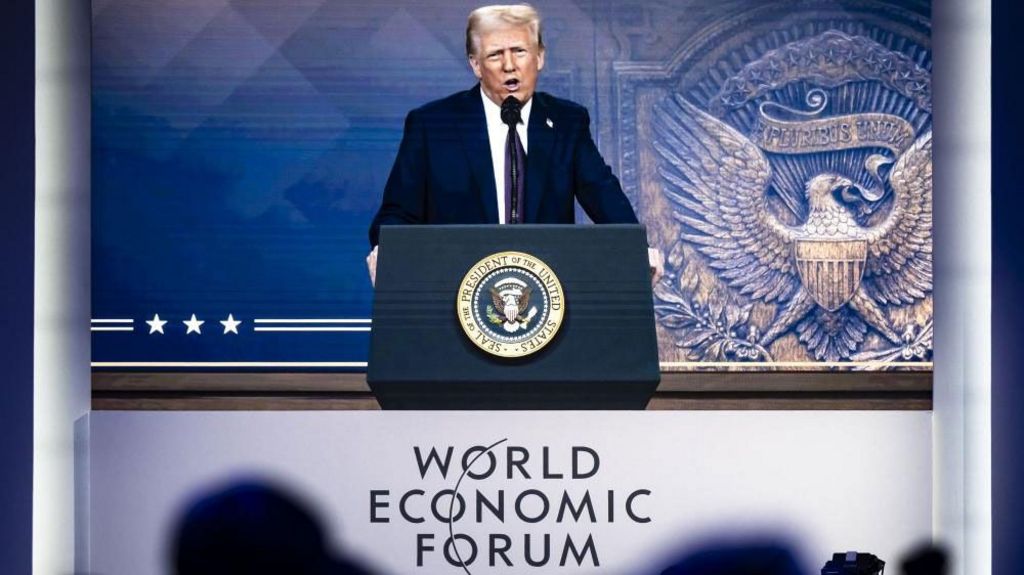
The pristine slopes of Davos provide an incongruous backdrop for what promises to be one of the most politically charged World Economic Forum gatherings in recent memory. President Donald Trump’s scheduled appearance Wednesday marks his physical debut at the Alpine summit following last year’s remote participation just days after his inauguration.
The American president returns as what analysts term the ‘chief global disruptor,’ bringing with him an entourage of five cabinet members and corporate titans including Nvidia’s Jensen Huang and Microsoft’s Satya Nadella. His presence has dramatically amplified attendance figures, creating the largest Davos congregation on record.
Central to the geopolitical tension is Trump’s extraordinary territorial ambition regarding Greenland—a proposition that has left European leaders both bewildered and concerned. The administration’s attempt to economically pressure Europe into selling the autonomous Danish territory represents precisely the type of unilateral action that contradicts the forum’s official theme of ‘spirit of dialogue.’
This year’s proceedings unfold under unusual circumstances, with reports suggesting the White House pressured organizers to minimize traditional focus areas like environmental sustainability and global development in favor of hardline business discussions. The creation of a ‘USA House’ in a local church—funded by American corporations to celebrate the World Cup and 250th anniversary of U.S. independence—further underscores the administration’s America-first approach.
The forum gathers an unprecedented 65 heads of state alongside Ukrainian President Volodymyr Zelensky, 850 top executives, and numerous technology pioneers. This concentration of global leadership has sparked comparisons to historic summits like Yalta, particularly given ongoing border disputes from Venezuela’s Caracas to Ukraine’s Donbas region.
While Trump champions economic nationalism, Canadian leadership presents a contrasting vision of North American cooperation. Prime Minister Mark Carney arrives having successfully navigated U.S. trade turbulence through diversified partnerships and strengthened multilateral alliances, recently advocating for a new world order alongside Chinese leadership.
China’s substantial delegation, operating at finance minister level, positions the world’s second-largest economy as a stabilizing force amid American disruption. Their growing technological dominance—evidenced by last year’s surprise emergence of the DeepSeek AI chatbot that overshadowed early-week American triumphalism—signals a fundamental power shift that many European manufacturers now acknowledge as irreversible in critical sectors like electric vehicle batteries.
Despite frequent criticisms of the Davos concept, this year’s forum offers a unique lens through which to observe the accelerating reorganization of global influence and the competing visions for international cooperation in an increasingly fragmented world.