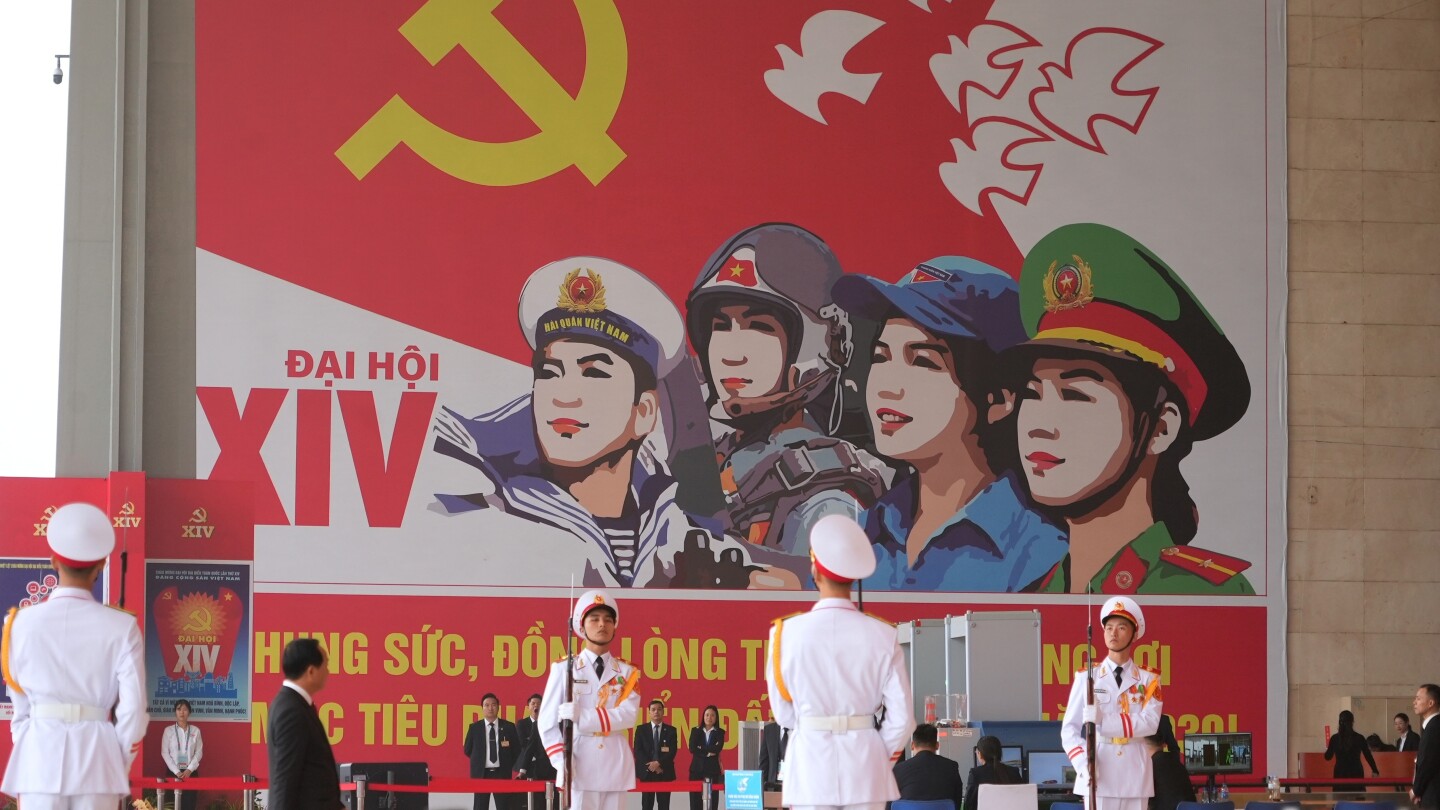
HANOI, Vietnam — Vietnam’s political landscape enters a pivotal phase as the ruling Communist Party commenced its five-year National Congress on Monday. This critical gathering brings together 1,588 delegates in Hanoi to determine the nation’s leadership structure and policy trajectory through 2031.
The conclave represents the party’s supreme decision-making authority, convening every five years to elect approximately 200 Central Committee members. This body subsequently appoints 17-19 individuals to the influential Politburo through a meticulously orchestrated selection process.
At the forefront of deliberations is Communist Party General Secretary To Lam, anticipated to secure a full five-year term. Significant attention focuses on whether Lam will consolidate power by assuming both party leadership and state presidency roles—a potential departure from Vietnam’s traditional ‘four pillars’ governance model that maintains balance between party chief, president, prime minister, and National Assembly chair. Such consolidation would mirror political structures in China under Xi Jinping and neighboring Laos.
Lam’s political ascent stems from his tenure as Minister of Public Security since 2016, where he spearheaded the extensive anti-corruption initiative championed by predecessor Nguyen Phu Trong. His administration has implemented the most substantial bureaucratic and economic reforms since Vietnam’s late-1980s economic liberalization, including significant public-sector workforce reduction, administrative boundary restructuring, and initiation of major infrastructure projects.
Analysts note internal party dynamics between Lam’s security-aligned faction and more conservative military-associated elements. According to Nguyen Khac Giang of Singapore’s ISEAS–Yusof Ishak Institute, conservatives express concern about potential deviation from socialist principles and advocate for maintaining checks on concentrated power.
The Congress simultaneously addresses Vietnam’s ambitious development agenda, particularly its goal of achieving high-income economy status by 2045. Delegates are finalizing a resolution targeting unprecedented 10% average annual GDP growth from 2026-2030, building upon 2025’s 8% expansion despite previous shortfalls in growth targets.
This economic vision emphasizes industrial upgrading, production modernization, and technology-driven growth, exemplified by military-run Viettel’s inaugural semiconductor chipmaking plant launched in January. The project aims for trial production by 2027, representing Hanoi’s strategic push for technological self-reliance.
Notably, draft documents recognize the private sector as ‘one of the most important driving forces of the economy,’ signaling a potential shift from state-owned enterprise dominance. The resolution equally prioritizes foreign relations with national security, acknowledging Vietnam’s export economy’s global interdependence, while elevating environmental protection to central status alongside economic and social development.