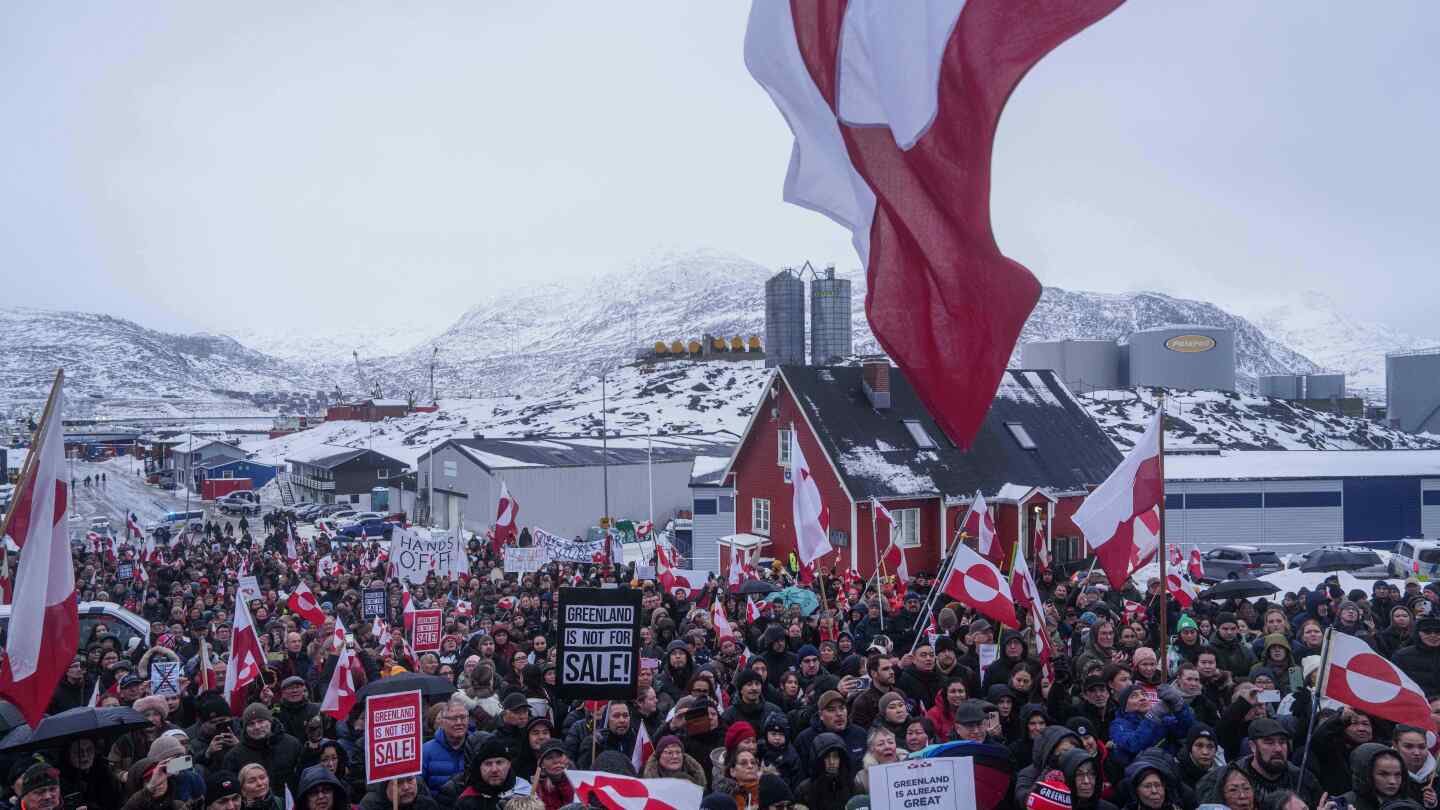
BERLIN (AP) — Transatlantic relations faced severe strain Sunday following President Donald Trump’s unexpected announcement imposing 10% tariffs on eight European nations for resisting U.S. territorial ambitions regarding Greenland. The move has triggered widespread condemnation across European capitals and prompted emergency diplomatic consultations.
The targeted nations—Denmark, Norway, Sweden, France, Germany, United Kingdom, Netherlands, and Finland—collectively denounced the measures as economically damaging and politically destabilizing. European Council President António Costa and European Commission President Ursula von der Leyen issued a joint statement warning the tariffs “would undermine transatlantic relations and risk a dangerous downward spiral.”
Trump’s tariff threat, announced Saturday coinciding with mass protests outside the U.S. Consulate in Nuuk, Greenland’s capital, represents an unconventional approach to territorial negotiation. The administration characterizes Greenland as critical to U.S. national security interests, though the semiautonomous territory remains under Danish sovereignty within the NATO alliance framework.
Legal and logistical complications immediately emerged regarding implementation. The European Union functions as a unified economic zone in trade matters, while targeted nations Norway and Britain operate outside EU trade structures. EU envoys scheduled emergency talks for Sunday evening to coordinate response strategies.
The announcement generated rare bipartisan criticism within both European and American political spheres. U.S. Senator Mark Kelly (D-Arizona) condemned the move as damaging to international relationships, stating: “The damage this President is doing to our reputation and our relationships is growing, making us less safe.”
European leaders expressed concern that the confrontation might benefit geopolitical rivals. EU Foreign Policy Chief Kaja Kallas noted that “China and Russia will benefit from the divisions between the U.S. and Europe,” emphasizing that Greenland security concerns should be addressed through NATO mechanisms rather than economic coercion.
Even Trump’s traditional European allies distanced themselves from the move. French far-right leader Jordan Bardella recommended suspending the EU-U.S. tariff agreement, characterizing the threat as “commercial blackmail.” British political parties across the spectrum, including Trump ally Nigel Farage’s Reform UK, uniformly criticized the measures.
Danish and Norwegian foreign ministers are scheduled to address the escalating crisis during a Sunday news conference in Oslo, as diplomatic efforts intensify to resolve the unprecedented transatlantic confrontation.