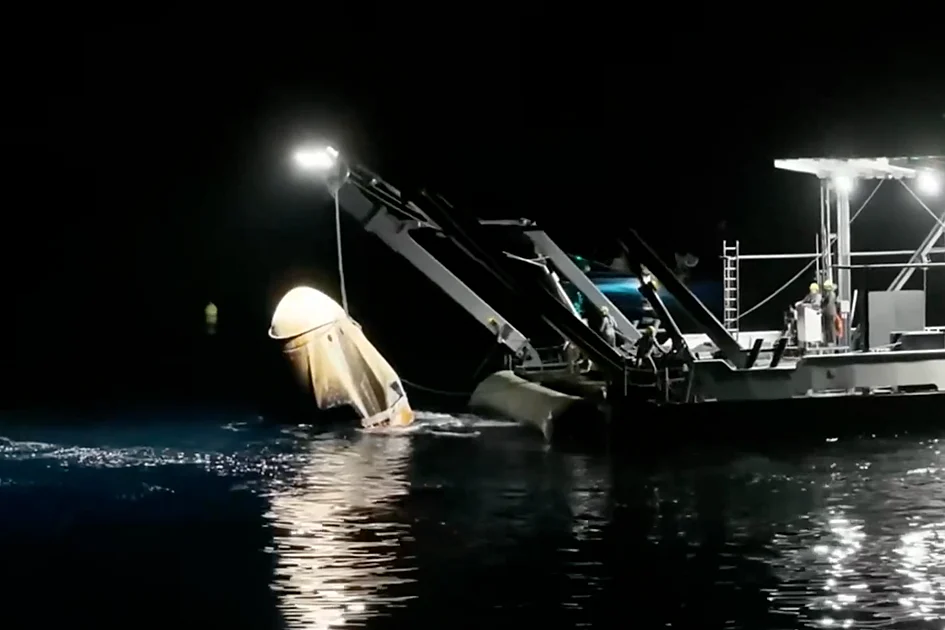
In an unprecedented operation marking the first medical evacuation from the International Space Station, four astronauts successfully returned to Earth aboard a SpaceX capsule that splashed down in the Pacific Ocean near San Diego at 12:41 AM local time (0841 GMT) on Thursday. The Crew-11 mission members—American astronauts Mike Fincke and Zena Cardman, Russian cosmonaut Oleg Platonov, and Japanese astronaut Kimiya Yui—cut their five-month mission short due to an undisclosed medical condition affecting one crewmember.
NASA officials maintained that the situation did not constitute an emergency evacuation but rather a precautionary measure. “The affected crewmember was and continues to be in stable condition,” stated NASA spokesperson Rob Navias. Astronaut Fincke emphasized via social media that all crew members were “stable, safe, and well cared for,” describing the decision as “deliberate” to allow proper medical evaluation on Earth where comprehensive diagnostic capabilities exist.
The mission, originally scheduled to continue until mid-February, was shortened following medical consultations. NASA’s chief health and medical officer, James Polk, cited “lingering risk” and diagnostic uncertainties as factors in the decision. The evacuated astronauts had received extensive training for medical emergencies, with senior NASA official Amit Kshatriya praising their professional handling of the situation.
Three crewmembers—American astronaut Chris Williams and Russian cosmonauts Sergey Kud-Sverchkov and Sergei Mikaev—remain aboard the ISS, which continues normal operations. The station, a symbol of international cooperation continuously inhabited since 2000, serves as a critical testing ground for deep space exploration technologies. NASA and Roscosmos maintain their collaborative operation of the orbital laboratory, one of the few enduring areas of U.S.-Russia cooperation.
The ISS, orbiting approximately 400 kilometers above Earth, is scheduled for decommissioning after 2030, with plans to gradually lower its orbit until it breaks up in the atmosphere over the remote Pacific region known as Point Nemo.