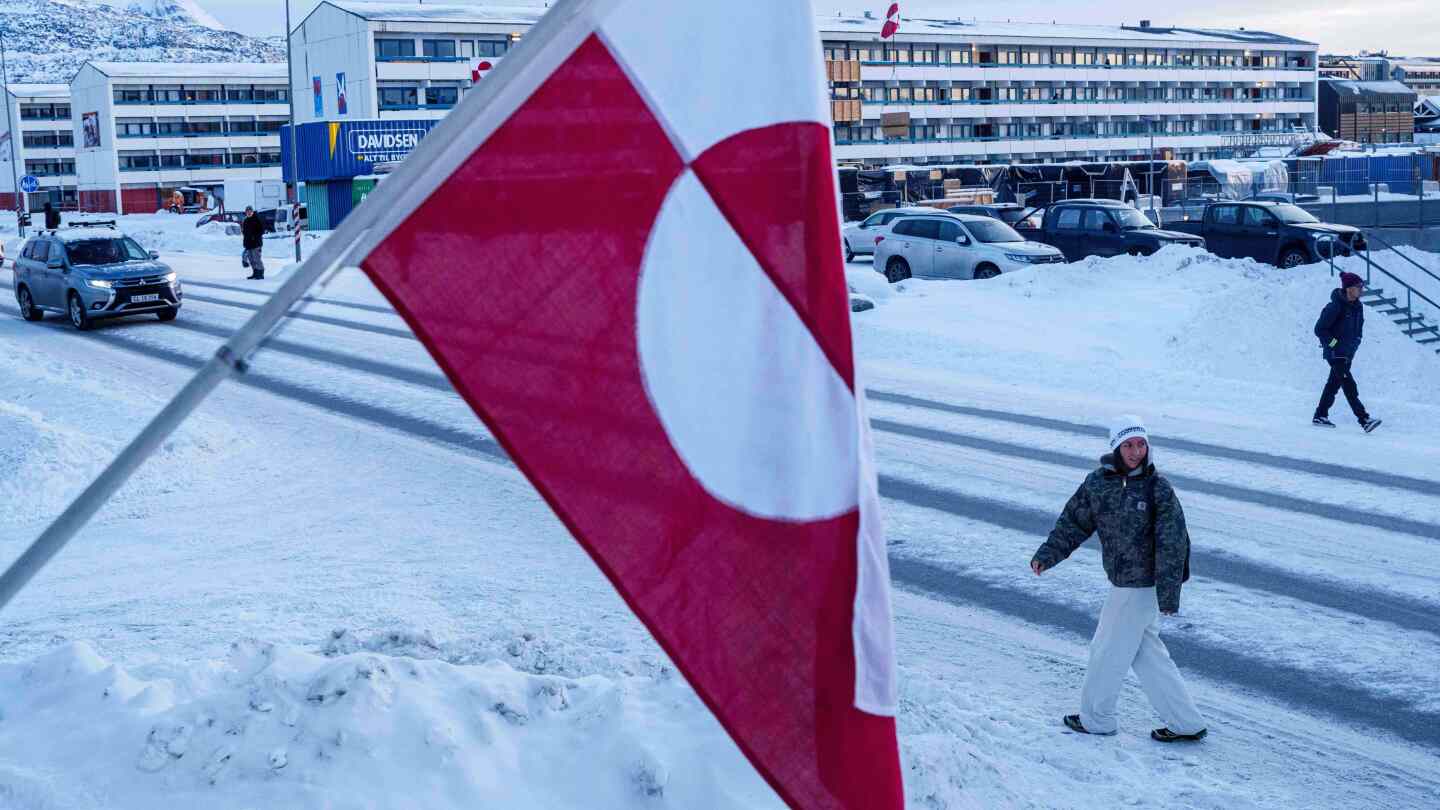
NUUK, Greenland — The Arctic island of Greenland has become an unexpected focal point in international diplomacy following U.S. President Donald Trump’s expressed interest in acquiring the territory, including suggestions of potential military action. This semiautonomous Danish territory finds itself at the center of a geopolitical storm that has profoundly impacted its citizens.
Greenlandic Minister Naaja Nathanielsen revealed the psychological toll on the population, stating that anxiety has become pervasive with “people not sleeping, children are afraid, and it just fills everything these days” during a parliamentary meeting in London.
The situation escalated following a White House meeting between Trump and Danish officials, where a “fundamental disagreement” regarding Greenland’s status was acknowledged. Trump’s dismissive characterization of Denmark’s defensive capabilities in Greenland as “two dog sleds” has been particularly damaging to Greenlandic cultural pride.
Mari Laursen, a law student and former fishing trawler worker, criticized Trump’s remarks as “undermining us as a people,” highlighting the historical cooperation between Greenlandic hunters and U.S. forces during World War II when dog sled teams helped detect Nazi German presence. “The Arctic climate and environment is so different from maybe what Americans are used to,” Laursen explained. “A dog sled is more efficient. It can go where no warship and helicopter can go.”
Greenlanders uniformly rejected Trump’s claims of Russian and Chinese naval activity in their waters. Lars Vintner, a heating engineer, stated bluntly: “I think he should mind his own business. We are only 57,000 people. The only Chinese I see is when I go to the fast food market.” Fisherman Gerth Josefsen corroborated this assessment, noting he had only seen “a Russian fishing boat ten years ago.”
Many Greenlanders perceive economic motivations behind American interest, particularly regarding the island’s untapped mineral resources and oil reserves. Shop worker Maya Martinsen, 21, asserted: “I know it’s not national security. I think it’s for the oils and minerals that we have that are untouched,” suggesting Americans were treating her homeland as a “business trade.”
The potential loss of Greenland’s social benefits under American administration concerns many residents. Student Tuuta Mikaelsen, 22, emphasized: “There are laws and stuff, and health insurance…we can go to the doctors and nurses…we don’t have to pay anything. I don’t want the U.S. to take that away from us.”
Greenlandic parliament member Juno Berthelsen, whose opposition party campaigns for independence, reported conducting multiple daily media interviews throughout the crisis. He advocated for diplomatic solutions, noting that “a lot of Republicans as well as Democrats are not in favor of having such an aggressive rhetoric and talk about military intervention.”
Berthelsen concluded with a definitive statement on Greenland’s sovereignty: “It is our country. Greenland belongs to the Greenlandic people.”