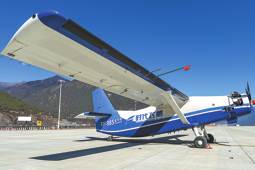
China’s aerospace sector has achieved a significant technological breakthrough with the successful completion of an ambitious high-altitude flight test by the FP-985 Taurus, a large fixed-wing cargo drone. The unmanned aircraft demonstrated exceptional performance during a transprovincial journey across some of China’s most challenging plateau terrain.
The prototype embarked on its landmark mission from Mainling Airport in Nyingchi, located within the Xizang Autonomous Region. This airport presents exceptional operational difficulties due to its elevation of approximately 2,900 meters and its precarious positioning within narrow, cloud-enshrouded river valleys. The drone, laden with regional specialties including traditional butter tea and yak dairy products, navigated the complex western foothills of the Himalayan mountains during its carefully planned route.
Following three hours and forty-four minutes of flight, covering approximately 800 kilometers and reaching altitudes of 7,500 meters, the aircraft executed a precision landing at Kangding Airport in Sichuan’s Garze Tibetan Autonomous Prefecture. Situated at over 4,200 meters above sea level, Kangding ranks among the world’s highest-altitude airports. The demonstration continued as the drone departed Kangding, ultimately concluding its 1,200-kilometer journey at Beichuan Yongchang Airport in Mianyang.
Developed by Aerospace Times Feipeng, a subsidiary of China Aerospace Science and Technology Corporation, the FP-985 Taurus represents a specialized solution for operations in geographically complex regions including plateaus and remote islands. The aircraft boasts impressive technical specifications: maximum takeoff weight of 5.7 metric tons, payload capacity exceeding 2 tons, and an operational range beyond 2,000 kilometers.
Engineered for versatility, the drone features short takeoff and landing capabilities adaptable to both standard and poorly-equipped airfields. Advanced systems include comprehensive anti-icing and de-icing mechanisms, lightning protection, and enhanced wind resistance.
The manufacturer emphasizes the drone’s potential to transform logistics in remote high-altitude regions, addressing persistent challenges of extended transit times, elevated risks, and limited transportation alternatives. The company projects that unmanned low-altitude transportation will significantly improve the delivery efficiency of agricultural products and time-sensitive supplies across western China, while simultaneously supporting regional economic development, major infrastructure projects, and enhanced emergency response capabilities.