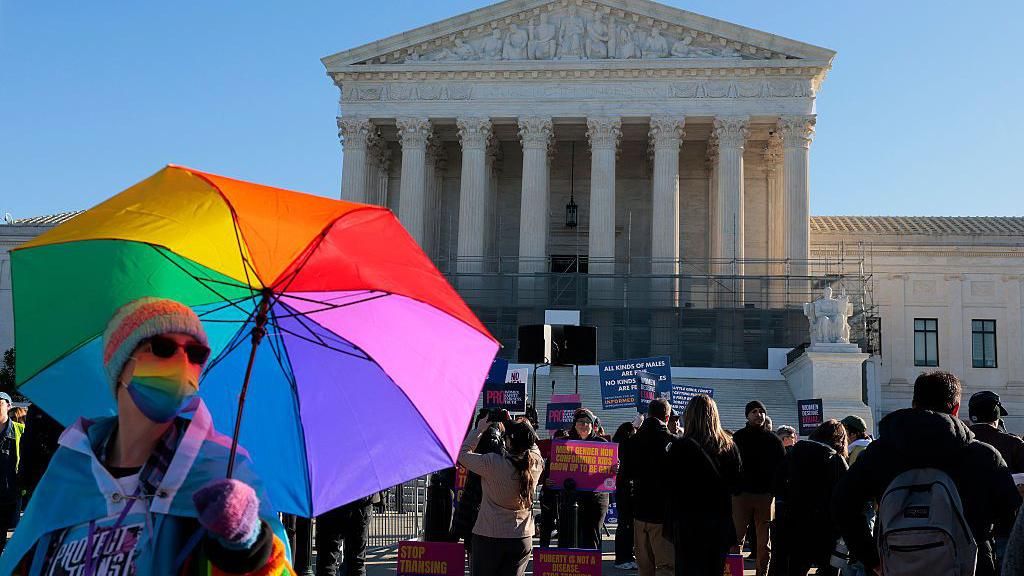
The United States Supreme Court appears poised to uphold state-level prohibitions preventing transgender women and girls from competing on female sports teams in educational institutions. During extensive oral arguments spanning over three hours on Tuesday, a majority of justices demonstrated inclination toward validating athletic bans enacted across multiple states.
The court examined consolidated cases originating from Idaho and West Virginia, where plaintiffs challenge statutes mandating sports team designation based on biological sex recorded at birth. In Idaho, a transgender college student contends the prohibition violates constitutional equal protection guarantees, while a West Virginia high school student asserts the ban contravenes federal civil rights legislation.
Idaho Solicitor General Alan Hurst defended the state’s pioneering 2020 legislation, arguing before the court that ‘Idaho’s law classifies on the basis of sex, because sex is what matters in sports. It correlates strongly with countless athletic advantages, like size, muscle mass, bone mass and heart and lung capacity.’
Justice Brett Kavanaugh highlighted the national divide in approaches, questioning judicial intervention ‘when half the states are allowing transgender athletes to participate, half are not’ amid ongoing societal debate. With the court’s 6-3 conservative majority, the three liberal justices and plaintiffs’ counsel advocated for narrow adjudication or complete dismissal of the cases.
Notably, Idaho plaintiff Lindsay Hecox has withdrawn from university sports and attempted to retract her lawsuit, while West Virginia’s case involves a single student, Becky Pepper-Jackson, who sought to join her school’s track team at age 11.
The proceedings revealed complex legal considerations regarding historical discrimination comparisons and physiological competitive advantages. Lawyers for the athletes suggested distinguishing between transgender athletes using testosterone-suppressing medication and others, emphasizing that mitigated ‘sex-based advantages’ might permit competition without undermining women’s sports.
This judicial review occurs against a political backdrop where recent polling indicates bipartisan opposition to transgender participation in women’s sports, and follows the court’s previous conservative alignment in upholding restrictions on youth gender transition treatments. A final decision is anticipated in June, potentially establishing nationwide precedent for one of America’s most contentious social policy debates.