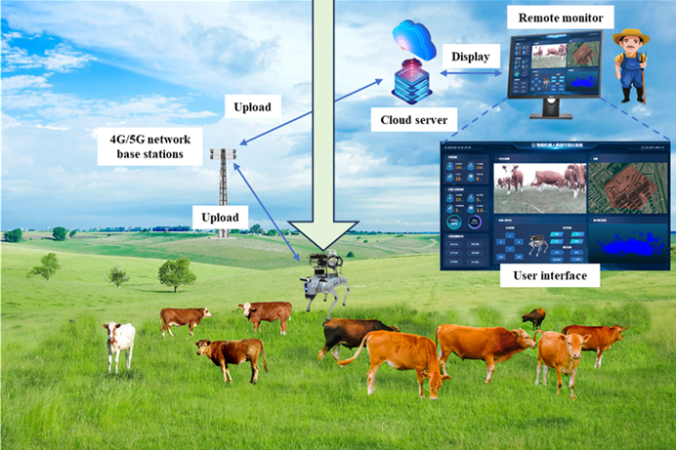
Chinese researchers have achieved a technological breakthrough in agricultural robotics with the development of MASM-YOLO, an advanced computer vision system designed to transform livestock management. The innovative artificial intelligence model enables quadruped robots to accurately interpret cattle behavior in real-time within complex grassland environments.
Developed by the Agricultural Information Institute of the Chinese Academy of Agricultural Sciences, this lightweight neural network represents a significant advancement in precision livestock farming. The system specializes in identifying six fundamental bovine behaviors—feeding, resting, locomotion, licking, and additional critical activities—despite challenging environmental conditions including variable lighting, motion blur, and physical obstructions within herds.
The technological architecture incorporates a Multi-Scale Focus and Extraction Network combined with an Adaptive Decomposition and Alignment Head. These sophisticated components work in concert to overcome traditional limitations in outdoor animal monitoring, maintaining detection accuracy while optimizing computational efficiency for mobile platform deployment.
This research, recently published in the authoritative journal Computers and Electronics in Agriculture, addresses a crucial need in modern animal husbandry. Accurate behavioral recognition forms the foundation for numerous management applications including early disease detection, estrus cycle monitoring, calving prediction, and overall health assessment of beef cattle populations.
The development marks a pivotal step toward fully autonomous grazing robots capable of intelligent herd management. By providing robots with sophisticated visual interpretation capabilities, the technology promises to enhance operational efficiency, reduce labor requirements, and improve animal welfare standards in agricultural practices.