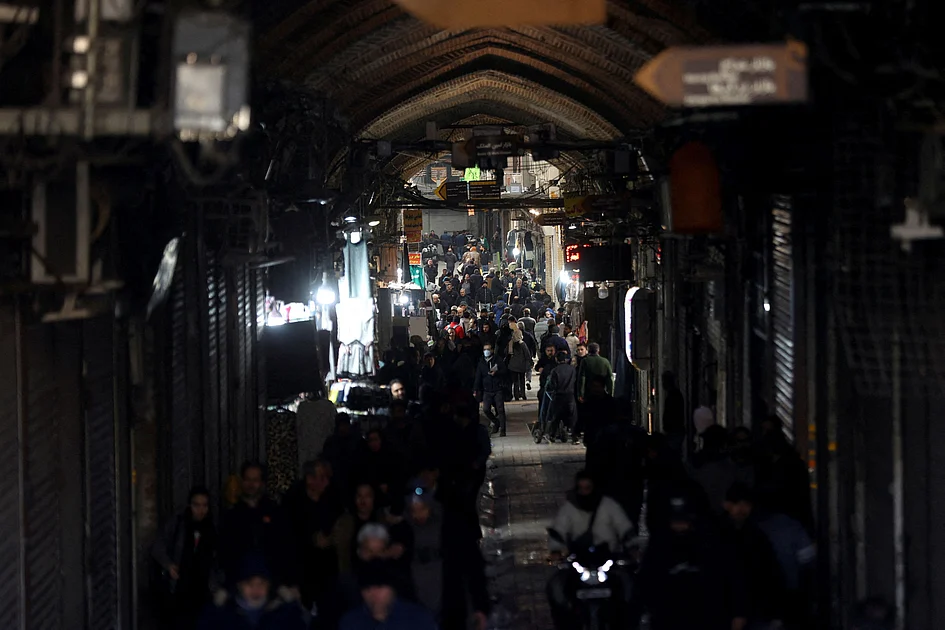
Iran’s clerical establishment faces a profound crisis of legitimacy as anti-government demonstrations that originated in Tehran last month have now expanded across all 31 provinces, creating the most significant challenge to the Islamic Republic in recent years.
The current unrest, while not yet reaching the scale of the 2022-2023 protests triggered by Mahsa Amini’s death, represents a broader coalition of dissent. Initially sparked by economic grievances among Tehran’s Grand Bazaar merchants angered by the rial’s sharp depreciation, the movement has evolved to include predominantly young men—a demographic shift from the previous female-led protests.
According to the U.S.-based Human Rights Activists News Agency (HRANA), the turmoil has resulted in at least 34 protester fatalities, four security personnel deaths, and approximately 2,200 arrests. Analysts interpret these developments as evidence of deepening disillusionment with the Shi’ite establishment.
Alex Vatanka, director of the Iran Program at the Middle East Institute in Washington, D.C., observed: ‘The collapse is not just of the rial but of trust.’
Authorities have adopted a dual strategy, acknowledging the legitimacy of economic protests while employing tear gas and forceful measures during street confrontations. This approach highlights the regime’s struggle to reconcile its revolutionary priorities with the aspirations of a youthful population.
Mina, a 25-year-old unemployed university graduate from Kuhdasht in Lorestan province, expressed a common sentiment: ‘I just want to live a peaceful, normal life… Instead, they insist on a nuclear programme, supporting armed groups in the region, and maintaining hostility toward the United States. Those policies may have made sense in 1979, but not today.’
Verified videos from Mashhad show protesters tearing down the Iranian flag, while clashes occurred in Tehran’s Grand Bazaar. Additional footage from Gonabad depicted young men abandoning a seminary mosque to join cheering crowds in what appeared to be a symbolic revolt against the clergy.
Vatanka suggests the clerical system’s survival strategy—combining repression with tactical concessions—may be reaching its limits. ‘Change now looks inevitable; regime collapse is possible but not guaranteed,’ he noted.
The geopolitical dimension intensified when U.S. President Donald Trump hinted at potential intervention, stating on January 2: ‘We are locked and loaded and ready to go.’ This followed a 12-day military conflict seven months prior involving Israeli and U.S. bombing of Iranian nuclear sites.
Supreme Leader Ayatollah Ali Khamenei, facing one of the most precarious moments of his decades-long rule, vowed Iran ‘will not yield to the enemy.’ However, analysts note the 86-year-old leader’s policies—including proxy network development, sanction evasion, and nuclear advancement—appear to be unraveling.
Within Iran, opinions remain divided regarding foreign intervention. A 31-year-old Isfahan resident captured the ambivalence: ‘Enough is enough. For 50 years this regime has been ruling my country. Look at the result. We are poor, isolated and frustrated.’ When asked about foreign military support, he responded: ‘No. I don’t want my country to suffer military strikes again. Our people have endured enough.’
Exiled opposition groups, though deeply fragmented, sense an opportunity to overthrow the establishment but face uncertainty regarding their domestic support base.