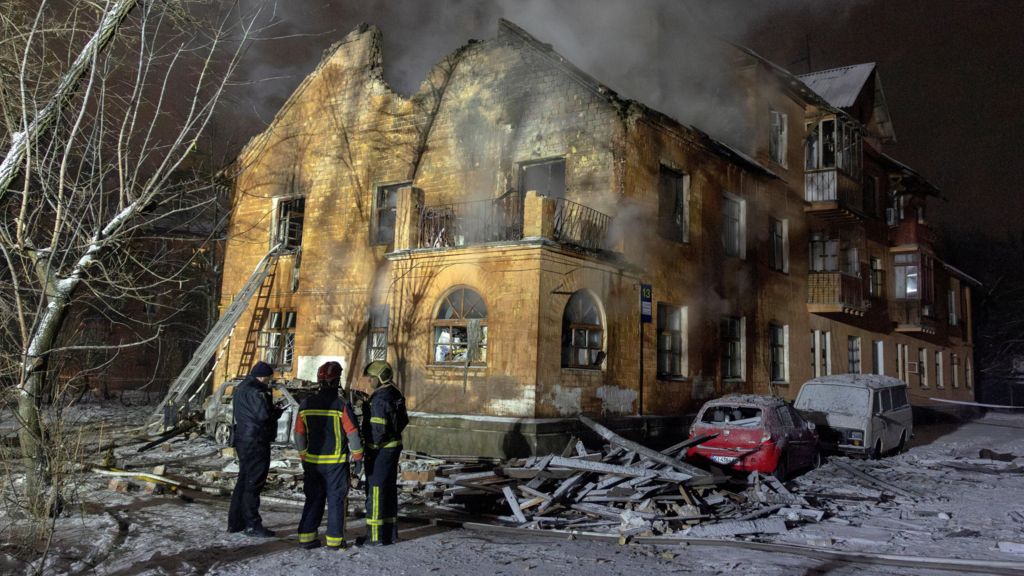
In a significant escalation of hostilities, Russia has confirmed deploying its advanced Oreshnik intermediate-range ballistic missile during a massive overnight assault on Ukrainian territory. The strikes resulted in four fatalities and twenty-five injuries in the capital city of Kyiv, where residents endured hours of deafening explosions that illuminated the night sky.
According to Russia’s defense ministry, this offensive operation was conducted as a retaliatory measure for an alleged Ukrainian drone attack on President Vladimir Putin’s residence in late December—an accusation that Ukrainian authorities vehemently deny. While the ministry did not identify specific targets for the Oreshnik missile, social media platforms circulated videos showing multiple explosions near Lviv, a western Ukrainian city located approximately 60 kilometers from the Polish border.
Ukrainian officials confirmed that ballistic missile strikes damaged critical infrastructure in the Lviv area. The Oreshnik system, first deployed in November 2024 against Dnipro, represents a formidable technological advancement with an estimated range of 5,500 kilometers. Its warhead is designed to fragment during final descent into multiple independently targeted projectiles, creating distinctive sequential explosions.
Ukrainian Foreign Minister Andrii Sybiha characterized the strike near NATO’s eastern flank as ‘a grave threat to European security and a test for the transatlantic community,’ dismissing Russia’s justification as based on ‘hallucinations.’ The European Union has expressed skepticism regarding Russia’s claims about the initial drone incident, with former U.S. President Donald Trump recently questioning whether the alleged attack on Putin’s residence ever occurred.
The assault on Kyiv involved sophisticated tactical coordination, employing over a dozen missiles and hundreds of drones. Tragedy struck when a paramedic responding to an initial explosion became a victim of a ‘double-tap’ strike—a military tactic where secondary explosives target first responders. Residential buildings along the Dnipro River and in central districts sustained direct hits, while power outages affected multiple neighborhoods during exceptionally harsh winter conditions, with temperatures expected to drop to -15°C.
Concurrently, Ukrainian forces targeted Russian energy infrastructure, with half a million residents in Belgorod losing power and the city of Oryol experiencing disruptions to water and heating systems following strikes on power plants. This reciprocal targeting of energy infrastructure has become a defining characteristic of the conflict, creating humanitarian challenges for civilians on both sides of the border.