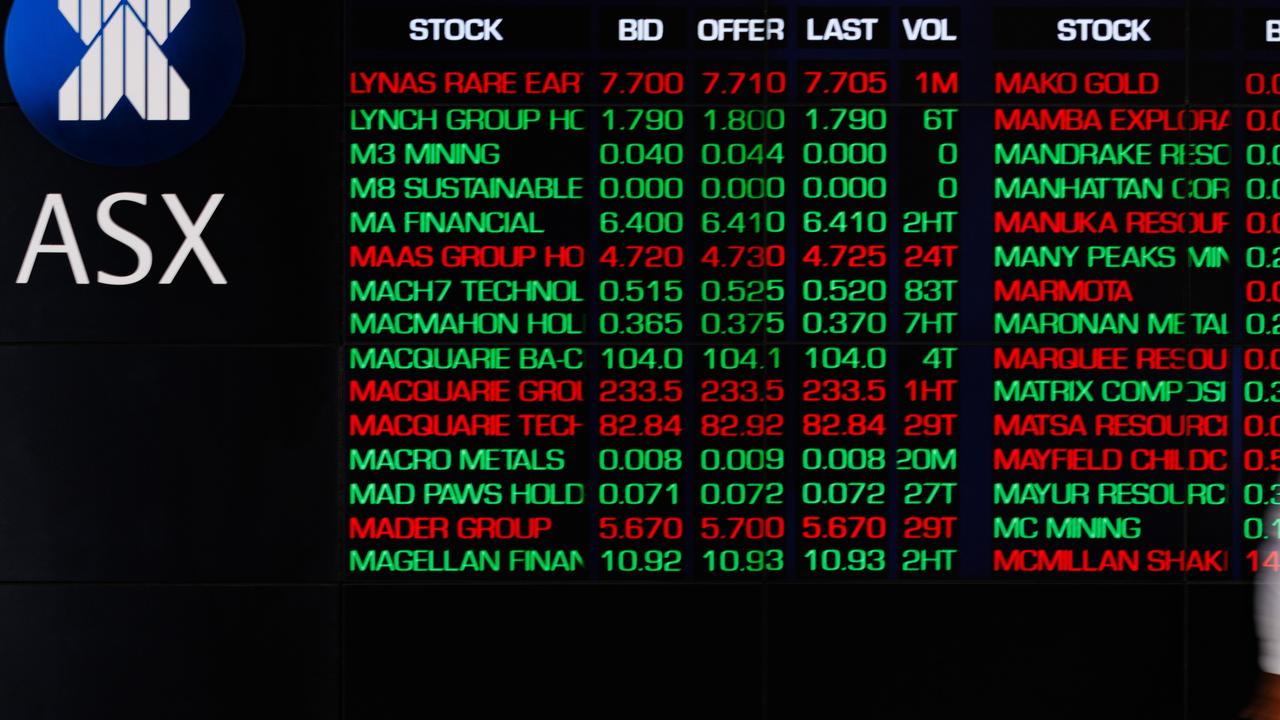
Australia’s equity markets closed higher on Wednesday, propelled by a dual catalyst of record-breaking commodity prices and a more favorable than anticipated inflation report. The benchmark S&P/ASX 200 index advanced by 12.80 points, a gain of 0.15 percent, to settle at 8695.60. The broader S&P/ASX All Ordinaries index also climbed, adding 21.10 points, or 0.23 percent, to finish the session at 9018 points.
The day’s rally was largely sector-driven, with eight out of eleven industry sectors finishing in positive territory. The materials sector emerged as a primary engine of growth, fueled by historic surges in key commodity markets. Copper prices on the London Metal Exchange shattered records, escalating by 1.8 percent to surpass $US13,300 per tonne. Concurrently, nickel reached a significant 15-month peak, trading above $US18,000 per tonne. This bullish sentiment propelled major mining giants; BHP Group ascended 1.02 percent to $47.70, and Rio Tinto gained 1.62 percent, closing at $154.73.
Gold miners also experienced substantial upward momentum as the precious metal’s price, a traditional safe-haven asset, breached $US4,495 per ounce. Leading the charge, Newmont Corporation’s stock jumped 2.75 percent to $158.50. Evolution Mining and Northern Star Resources followed suit, rising 1.33 percent and 0.83 percent, respectively.
These gains, however, were partially offset by notable declines in the energy and financial sectors. Energy stocks led the market’s losses as Brent crude oil prices dipped one percent to $US60.22 a barrel. Woodside Energy shares fell 2.81 percent, while Santos and Ampol declined 2.95 percent and 2.34 percent, respectively. The ‘Big Four’ banks also exerted downward pressure on the index. This sell-off was triggered by shifting market expectations regarding interest rates, following the latest inflation data.
The Australian Bureau of Statistics reported that the nation’s headline annual inflation rate moderated to 3.4 percent for the year to November, down from 3.8 percent. More critically, the trimmed mean inflation rate—a key measure closely watched by the Reserve Bank of Australia (RBA) as it excludes volatile items—eased to 3.2 percent from 3.3 percent. AMP Deputy Chief Economist Diana Mousina attributed this cooling to aggressive discounting during Black Friday sales, particularly in footwear, accessories, and furniture. She noted that the RBA’s upcoming February meeting remains a ‘live’ event, with the decision on a potential rate hike being too close to call.
In corporate developments, Lynas Rare Earths witnessed a spectacular surge of 14.52 percent following news of China’s ban on rare earth shipments. Respiratory imaging firm 4DMedical also saw its shares soar nearly 12 percent after announcing a new commercial agreement with UC San Diego Health.