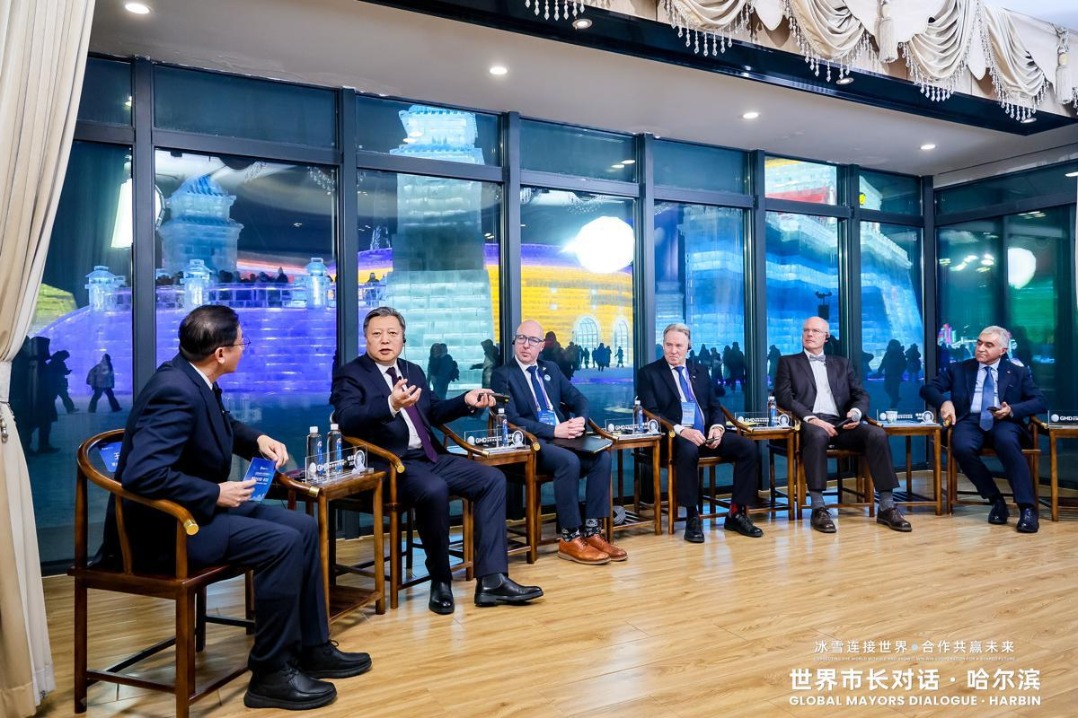
Harbin transformed into a diplomatic hub for cold-climate cities as mayors from across the globe gathered at the Ice and Snow World complex on Tuesday evening for the Global Mayors Dialogue. The international delegation—representing municipalities from Canada, Finland, Germany, Greece, South Korea, Thailand, and Türkiye—convened to exchange strategies for converting winter conditions into sustainable economic development.
Under the thematic framework “White Gold: Urban Development Driven by the Ice and Snow Economy,” the dialogue salon featured substantive discussions on transforming climatic challenges into opportunities. Li Mian, Executive Vice-Mayor of Harbin, revealed that the current Harbin Ice and Snow World occupies the global lead as the largest ice-themed park, utilizing 400,000 cubic meters of ice—equivalent to approximately 160 Olympic-sized swimming pools. The attraction recorded 3.56 million tourist visits during its 68-day operational period last winter.
“Harbin stands as China’s premier ice city, the cradle of modern winter sports, and an international hub for frost-season tourism,” Li declared. He elaborated on Harbin’s innovative approach to citywide tourism development, creating tailored experiences for diverse demographics and transforming the entire urban landscape into an integrated cultural destination rather than relying on isolated attractions.
International representatives shared parallel initiatives. Edmonton Mayor Andrew Knack described how his city reimagines winter as a cultural connector rather than a hardship, stating: “While many endure winter, cities like Harbin and Edmonton thrive through it. We create artistic festivals and sporting events that foster genuine community engagement.”
From Rovaniemi—the official hometown of Santa Claus—City Council Second Chairman Heikki Kontiosalo detailed how extended snow seasons become tourism assets through enhanced ski infrastructure and hospitality investments. Erzurum Vice-Mayor Zafer Aynali highlighted municipal management of ski centers and announced ambitious development targets for 2026-2027 following a successfully hosted world championship.
Even representatives from less frigid regions expressed interest in collaboration. Thorsten Kroll, Vice-Mayor of Magdeburg, noted his city’s limited snowfall but strong desire to partner with Harbin in tourism, pharmaceuticals, technology, and construction sectors.
The gathering demonstrated a growing international recognition of cryospheric economics as a viable development model, with Harbin positioning itself as a central node in this emerging global network.