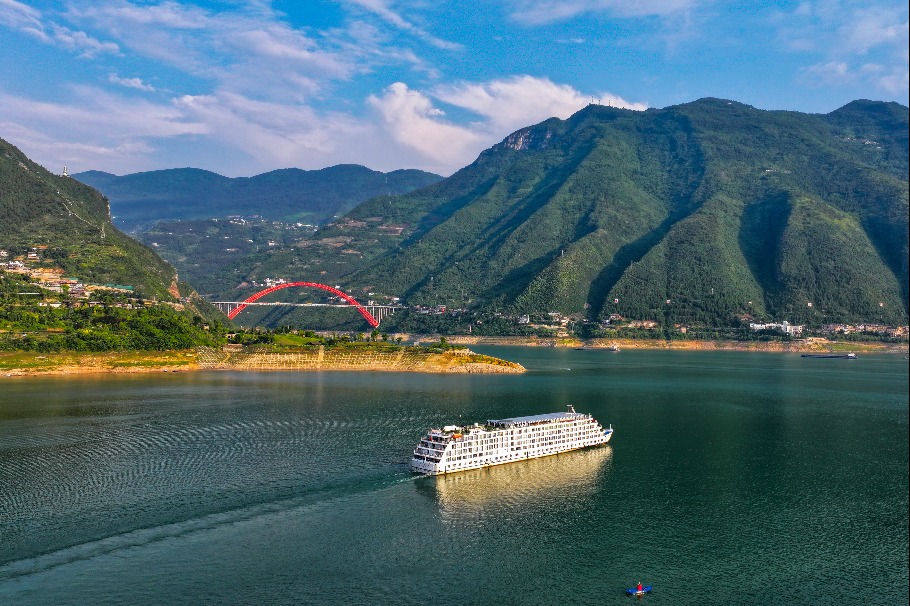
A remarkable ecological transformation is underway along China’s Yangtze River, reversing decades of environmental degradation through a comprehensive conservation strategy implemented over the past ten years. The 6,300-kilometer waterway, once described as “seriously ill” due to severe pollution and biodiversity loss, has achieved previously unimaginable water quality levels and witnessed the return of native fish species to long-barren stretches.
The watershed moment occurred on January 5, 2016, when Chinese leadership established the guiding principle that development along the Yangtze River Economic Belt must prioritize ecological protection and green development. This policy shift initiated a comprehensive approach combining strict environmental safeguards, structural economic reforms, and technology-driven governance across 11 provinces and municipalities that collectively generate nearly half of China’s GDP.
According to Wang Yanxin, academician of the Chinese Academy of Sciences, “The Yangtze conservation drive has woven environmental protection into the fabric of high-quality development, fundamentally reshaping the river basin’s growth model while accelerating transitions in production methods, energy systems, and rural community development.”
The most dramatic intervention came on January 1, 2021, with the implementation of a comprehensive 10-year fishing ban affecting more than 230,000 fishers across ten provincial regions. This unprecedented measure aimed to reverse the decline in aquatic biodiversity by halting exploitation entirely rather than merely managing it.
Chongqing municipality, serving as a critical ecological gateway in the river’s upper reaches, demonstrated the policy’s implementation challenges and successes. More than 5,300 fishing boats were retired and over 10,000 fishers transitioned to land-based livelihoods. Many former fishers, like 58-year-old Li Daiguo who now serves on a fisheries enforcement team, have found new purpose in river protection roles while applying their knowledge of the waterways.
Supported by technological innovation, Chongqing has deployed an AI-powered monitoring system integrating over 1,200 riverside cameras and numerous drones that automatically identify illegal fishing activities, pollution risks, and enforcement gaps. Local authorities report handling more than 5,000 alerts through this system, significantly enhancing regulatory effectiveness.
The ecological results are quantitatively demonstrated: high-quality water sections have increased from 82.3% in 2016 to over 98% today, while biodiversity shows strong recovery. The population of the iconic Yangtze finless porpoise reached 1,249 in 2023—a 23.4% increase from 2017—and surveys recorded 344 native fish species between 2021-2024, representing an increase of 36 species compared to the 2017-2020 period.
This conservation effort received robust legal foundation through China’s first river-basin-specific legislation, the Yangtze River Protection Law enacted in March 2021, which established ecological protection and green development as formal guiding principles.
Contrary to conventional wisdom that environmental protection hinders economic development, the Yangtze River Economic Belt has demonstrated simultaneous ecological and economic progress. Regional GDP has more than doubled over the past decade, with the economic belt’s contribution to national output increasing from 42.2% to 47.3% during this period.
The region has emerged as a dynamic innovation hub, producing internationally competitive technology companies including AI startup DeepSeek and robotics manufacturer Unitree Robotics, while developing world-class industrial clusters in automotive manufacturing and electronic information sectors.
The Yangtze River Delta exemplifies this integrated approach, where green industries achieve remarkable efficiency. New-energy vehicle production now takes as little as four hours through coordinated regional specialization: design and software development in Shanghai, battery systems installation in Anhui, final assembly in Jiangsu, and intelligent systems testing in Zhejiang.
The delta has become China’s largest automotive manufacturing hub, accounting for nearly 40% of the country’s new-energy vehicle output and over one-quarter of global production. Simultaneously, the region has phased out outdated industrial capacity, dismantling 1,361 illegal docks and standardizing or closing more than 200,000 discharge outlets along the Yangtze.
Wang Changlin, deputy head of the National Development and Reform Commission, emphasized that while the economic belt accounts for approximately one-third of China’s energy consumption and carbon emissions, it generates close to half of the country’s GDP, demonstrating its role as a testing ground for environmentally prioritized development.
Looking forward, sustained commitment will determine long-term success. The next phase of Yangtze protection will require enhanced technological application, closer coordination between pollution control and carbon reduction, and development of market-based mechanisms for environmental governance, according to experts involved in the initiative.