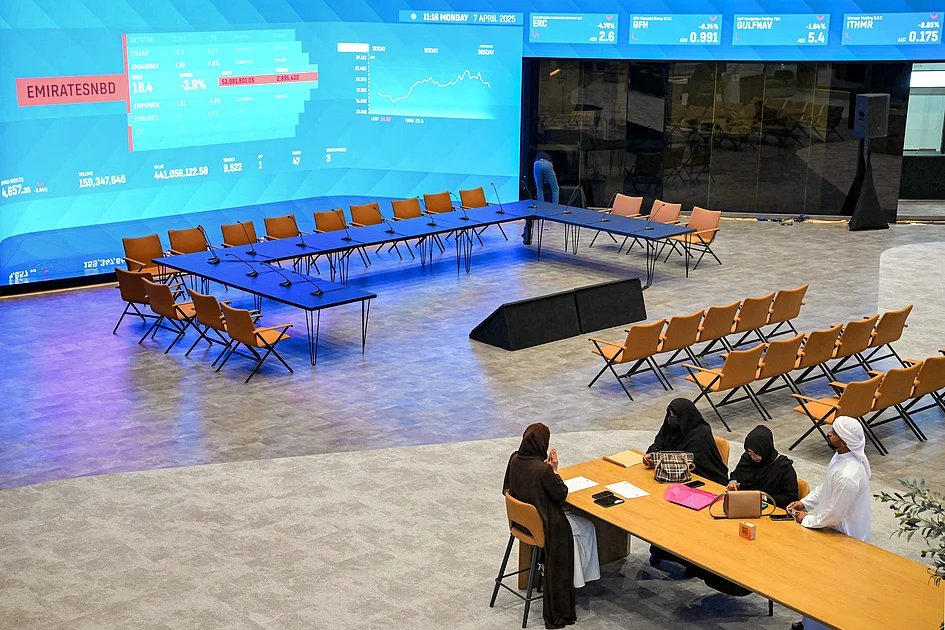
The Gulf Cooperation Council (GCC) equity markets concluded 2025 with markedly divergent performances, revealing a growing chasm between regional exchanges and their global counterparts. Dubai’s financial marketplace emerged as a regional luminary, showcasing remarkable resilience while other Gulf markets struggled to keep pace with worldwide rallies.
Dubai’s benchmark index soared 17.2% to close at 6,047.1 points, securing its position as the third-best performing market within the GCC region. This achievement marked the index’s fifth consecutive annual advance, demonstrating a maturing yet persistently robust upward trajectory. Sectoral performance revealed significant variations, with materials leading the charge at 29.9% growth, closely followed by communication services (29.5%) and industrials (28.1%). However, consumer discretionary sectors experienced substantial pressure, declining 24% and revealing underlying market fragmentation.
The Dubai Financial Market witnessed exceptional growth in market capitalization, climbing 14.7% year-on-year to reach Dh1.029 trillion. This expansion was fueled by vigorous initial public offering activity, particularly the Alec Holding IPO which attracted Dh29.8 billion in orders—representing a 21-times oversubscription—and raised Dh1.4 billion. Trading metrics showed pronounced acceleration, with volumes increasing 19.8% to 60.4 billion shares and traded value surging 55.3% to Dh161.8 billion. Emaar Properties dominated market turnover with Dh46.4 billion in traded shares, followed by Emaar Development and Emirates NBD.
Dubai’s equity market strength mirrored its formidable economic fundamentals. The emirate’s real estate sector recorded unprecedented performance, with transaction volumes rising 17.1% to 212.8 thousand deals and total sales values skyrocketing 27.3% to Dh667.6 billion. Apartment sales demonstrated particular vigor, with volumes up 19.3% and values increasing 25.4%. The International Monetary Fund projected Dubai’s GDP growth at 3.4% for 2025, acknowledging the emirate’s economic diversification and resilience amidst global uncertainties. Official data revealed GDP expansion of 4.4% during the first half of the year, propelled by construction sector growth of 8.5%.
Conversely, Abu Dhabi delivered a more tempered recovery. The ADX General Index advanced 6.1% to close at 9,992.72 points, rebounding from two consecutive years of decline. Market capitalization grew 3.7% to Dh3.03 trillion, supported by selective sectoral gains. Real estate led sectoral advances with a 15.4% increase, followed by telecommunications and financials. However, substantial declines in consumer staples, healthcare, and consumer discretionary stocks, coupled with a utilities sector retreat, constrained broader market progress.
Trading activity on the Abu Dhabi exchange remained vigorous, with volumes surging 35.3% to 85.8 billion shares and traded value rising 31.0% to Dh316.0 billion. International Holding Company, ADNOC Gas, and Aldar Properties emerged as the most actively traded stocks by value. Abu Dhabi’s property market demonstrated exceptional performance, with transaction values leaping 36% to Dh165.5 billion and volumes increasing 50%, reinforcing the emirate’s emergence as a transparent, well-regulated property destination. The IMF anticipates Abu Dhabi’s real GDP will expand by 6% in 2025, supporting a strengthened medium-term outlook.
Regionally, GCC markets substantially trailed global indices, with the MSCI GCC Index gaining merely 1.6% throughout 2025. Geopolitical tensions, crude oil weakness, and declines in heavyweight Saudi stocks exerted downward pressure. Brent crude prices fell 18.5% during the year, adversely affecting energy-concentrated markets. Saudi Arabia’s TASI declined 12.8%, representing the only GCC market to post an annual loss. Oman and Kuwait outperformed with gains of 28.2% and 21.0% respectively, positioning Dubai firmly among regional leaders.
Globally, equity markets celebrated a third consecutive year of double-digit gains, propelled by artificial intelligence stock rallies and accommodative monetary policies. Major benchmarks in the United States, Europe, and Asia advanced approximately 17%, while emerging markets surged over 30%, dramatically outperforming GCC indices. Against this backdrop, Dubai’s robust performance highlighted its increasing alignment with global growth narratives, even as the broader Gulf region contended with structural challenges and geopolitical headwinds.