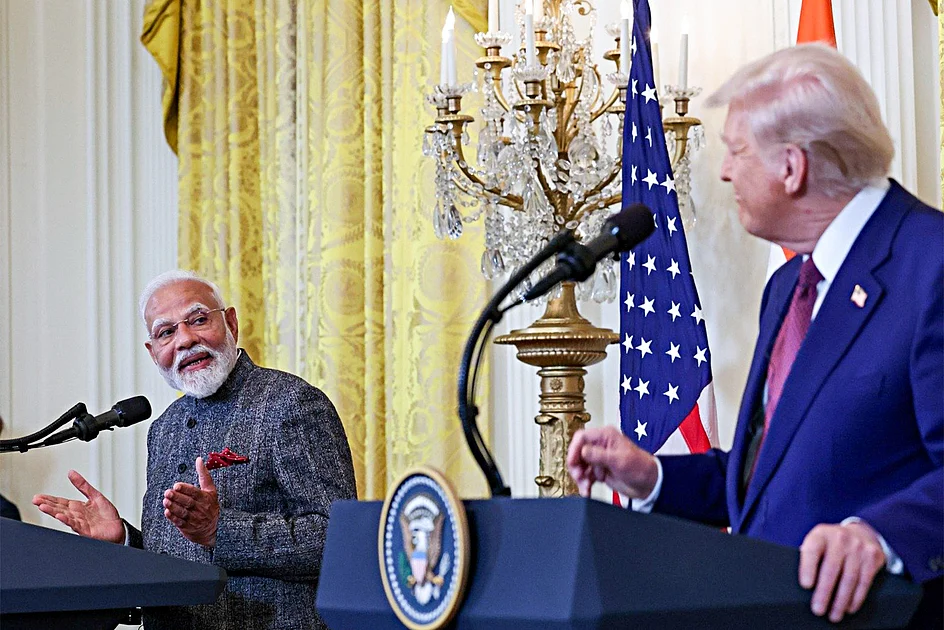
Former President Donald Trump has issued a stark warning to India regarding potential escalation of trade tariffs should New Delhi fail to address Washington’s concerns over its continued purchases of Russian oil. The remarks, delivered aboard Air Force One on Sunday, signal heightened tensions in bilateral trade relations that have been under negotiation for months.
Trump acknowledged Indian Prime Minister Narendra Modi as ‘a good guy’ while simultaneously emphasizing the urgency of resolving the oil import issue. ‘He knew I was not happy, and it was important to make me happy,’ Trump stated, adding that the U.S. possesses the capability to ‘raise tariffs on them very quickly’ if satisfactory progress isn’t achieved.
This development follows the United States’ decision last year to double import tariffs on Indian goods to 50 percent—a punitive measure directly linked to India’s substantial acquisitions of Russian crude. The existing tariffs have already impacted specific sectors, with India’s technology stock index experiencing a 2.5 percent decline to its lowest point in over a month as investors grow concerned about prolonged trade uncertainties.
Republican Senator Lindsey Graham, traveling with Trump and supporting legislative measures that could impose tariffs of up to 500 percent on nations purchasing Russian oil, framed the issue in geopolitical terms. ‘If you are buying cheap Russian oil, you keep Putin’s war machine going,’ Graham asserted, indicating that proposed legislation aims to empower the president with stronger economic leverage.
Trade analysts caution that India’s current ambiguous positioning may weaken its negotiating stance. Ajay Srivastava of the Global Trade Research Initiative noted that while Indian refiners have reduced Russian oil imports following sanctions, purchases haven’t ceased entirely, creating what he describes as a ‘strategic grey zone.’ Srivastava warned that even complete compliance might not alleviate U.S. pressure, which could subsequently shift to other trade demands.
Despite these challenges, India’s exports to the U.S. demonstrated surprising resilience with a significant increase recorded in November 2025, though overall shipments declined by more than 20 percent between May and November. The Indian government has implemented monitoring measures, requiring refiners to provide weekly disclosures of Russian and U.S. oil purchases to address American concerns.
Diplomatic engagements continue, with Modi and Trump having held at least three discussions since the imposition of tariffs, and commerce officials from both nations meeting last month. However, these talks have yet to yield a conclusive agreement, leaving trade relations in a state of precarious uncertainty.