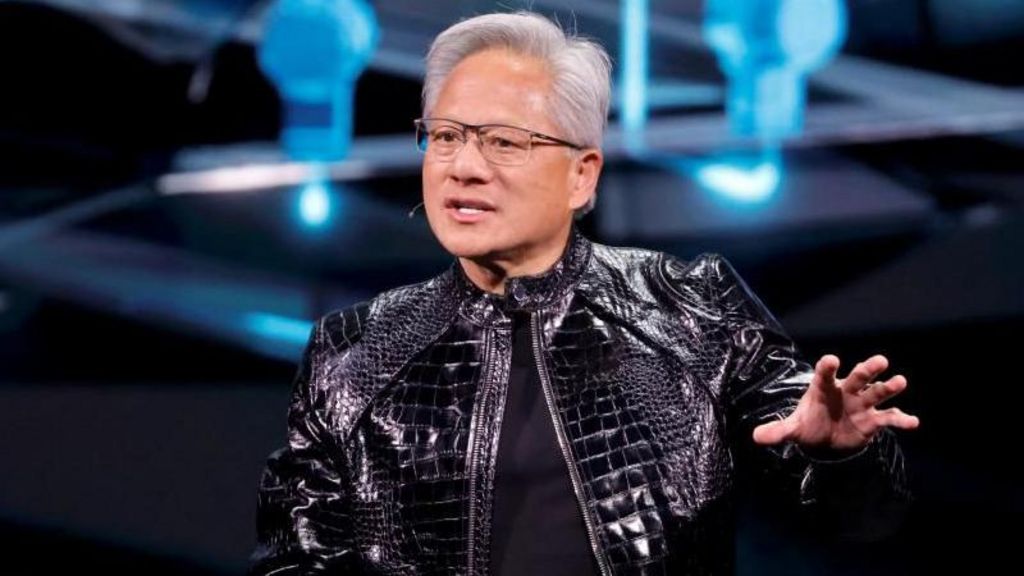
Nvidia CEO Jensen Huang unveiled a groundbreaking artificial intelligence platform named Alpamayo during his keynote address at the CES technology conference in Las Vegas on Monday. The revolutionary system represents a significant advancement in autonomous vehicle technology by enabling self-driving cars to engage in human-like reasoning processes when navigating complex scenarios.
The platform’s sophisticated architecture allows vehicles to analyze rare driving situations, operate safely in challenging environments, and provide detailed explanations for their driving decisions. Huang, wearing his characteristic black leather jacket, demonstrated the technology’s capabilities to hundreds of conference attendees through a video showing an AI-powered Mercedes-Benz CLA navigating San Francisco streets with a passenger whose hands remained in their lap throughout the journey.
In a major industry development, Nvidia announced it has commenced production of its first driverless vehicle in partnership with Mercedes-Benz. The collaborative effort will initially launch the autonomous CLA model in United States markets within coming months, followed by sequential releases across European and Asian markets. Huang emphasized that this project has provided Nvidia with invaluable insights into developing robotic systems for automotive partners.
Industry analysts immediately recognized the strategic significance of the announcement. Paolo Pescatore of PP Foresight noted from Las Vegas that “NVIDIA’s pivot toward AI at scale and AI systems as differentiators will help keep it way ahead of rivals.” This sentiment was reflected in market response as Nvidia shares experienced a slight increase during after-hours trading following the presentation.
In a move that could disrupt the autonomous vehicle sector, Huang revealed that Alpamayo will be available as an open-source AI model with underlying code accessible through machine learning platform Hugging Face. This approach allows autonomous vehicle researchers worldwide to freely access, modify, and retrain the model, potentially accelerating industry-wide development.
The announcement drew a pointed response from Tesla CEO Elon Musk, whose company develops the Autopilot driver assistance system. Musk commented on social media that “Well that’s just exactly what Tesla is doing,” while cautioning about the challenges in achieving full autonomy beyond 99% capability.
Nvidia, currently the world’s most valuable publicly traded company with a market capitalization exceeding $4.5 trillion, also provided updates on its Rubin AI chips currently in manufacturing. The new hardware promises enhanced computational efficiency with reduced energy consumption compared to current AI chips, potentially lowering development costs for AI technologies across multiple industries.