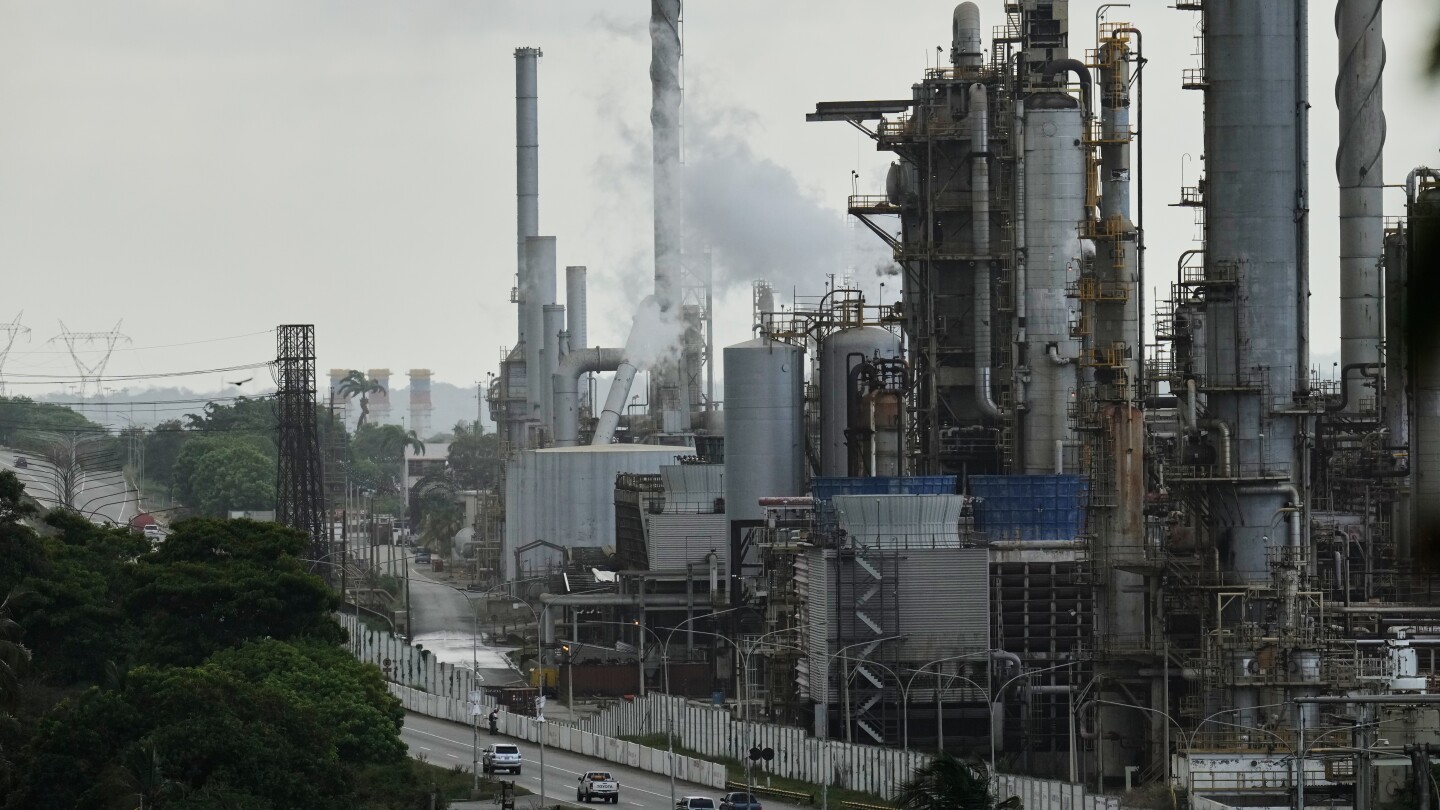
Financial markets witnessed a significant rally across the U.S. energy sector Monday, propelled by President Donald Trump’s announcement of American intentions to seize control of Venezuela’s oil industry. The declaration, which included plans for U.S. corporations to revitalize the nation’s crippled energy infrastructure following the capture of President Nicolás Maduro, triggered immediate investor optimism.
The immediate market response saw substantial gains for companies positioned to benefit from renewed Venezuelan production. Refining giants Valero, Marathon Petroleum, and Phillips 66 saw shares climb between 5% and 6% at the opening bell. Even more dramatic surges were observed in oilfield service corporations, with SLB and Halliburton jumping 7% to 8%. Major exploration firms including ExxonMobil, Chevron, and ConocoPhillips posted more modest gains of 2% to 4%.
This bullish sentiment stems from Venezuela’s potential to address a critical global shortage. The nation produces heavy crude oil, essential for manufacturing diesel fuel, asphalt, and other specialized industrial products. Current global sanctions on Venezuela and Russia have created a pronounced deficit in these materials, which cannot be easily substituted with America’s lighter crude varieties.
However, beneath the market euphoria lies a complex reality. Venezuela’s oil industry, currently producing approximately 1.1 million barrels per day, lies in profound disrepair after years of mismanagement and international sanctions. Analyst outlooks on recovery timelines diverge sharply. JPMorgan projects a relatively swift rebound, anticipating production could reach 1.3-1.4 million barrels daily within two years of a political transition, potentially expanding to 2.5 million over a decade with substantial investment and reform.
Conversely, other analysts express deep skepticism. Neal Dingmann of William Blair cautioned that political instability, inherent risks, and currently depressed global oil prices could deter the massive infrastructure investments required. He emphasized that material change would demand considerable time and millions of dollars, unlikely to occur imminently. This assessment is supported by current market conditions; U.S. crude prices remain down 20% year-over-year, struggling to surpass $70 per barrel and far from the $80 mark last seen in mid-2024.
The ultimate trajectory of Venezuelan oil production hinges on several unpredictable factors: the stability of a governmental transition, the speed and willingness of multinational oil companies to re-enter the high-risk environment, and the long-term outlook for global energy prices. While the Trump administration’s move ignited a market rally, the path to revitalizing Venezuela’s oil sector appears fraught with operational and economic challenges.