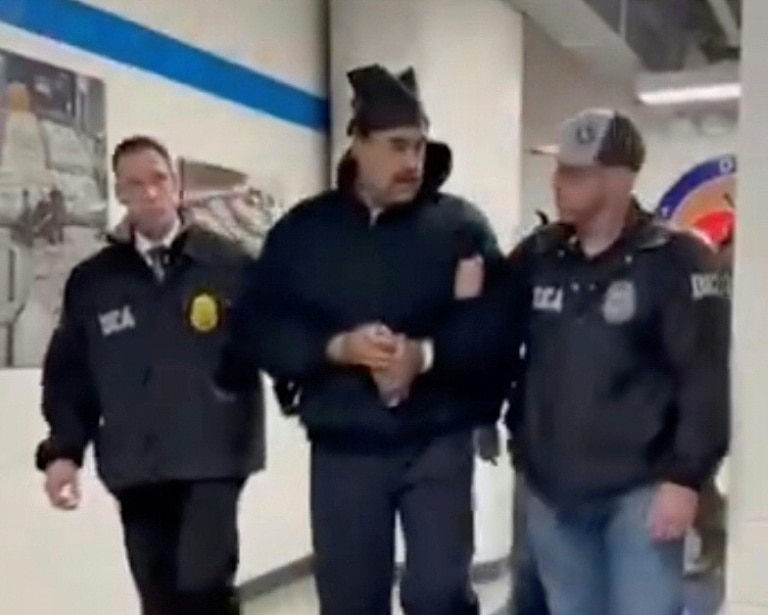
In a dramatic escalation of geopolitical tensions, former President Donald Trump has declared the United States to be ‘in charge’ of Venezuela, following a military operation that resulted in the capture of the nation’s deposed leader, Nicolás Maduro. The 63-year-old leftist strongman, along with his wife, was apprehended in a surprise assault involving commandos, aerial bombardment, and significant naval deployment off Venezuela’s coast. He now faces narcotrafficking charges in a New York courtroom.
The operation has triggered international outcry, prompting the UN Security Council to convene an emergency session at Venezuela’s request. Nations including China, Russia, and Iran condemned the action as a breach of international law, while some US allies expressed deep concern over the unilateral move. Chinese officials demanded Maduro’s immediate release, and Colombian President Gustavo Petro labeled the intervention an ‘assault on the sovereignty’ of Latin America, warning of potential humanitarian consequences.
In a surprising diplomatic shift, Delcy Rodríguez, Maduro’s successor and interim leader, softened her initial defiant stance and extended an offer of cooperation to the Trump administration. This conciliatory gesture came mere hours after Trump issued a stark warning, threatening that she would face a ‘very big price, probably bigger than Maduro’ if she resisted US demands. Trump explicitly stated that Washington requires ‘total access’ to Venezuela’s vast oil reserves and other resources, framing it as essential for rebuilding the nation.
The White House has clarified that its objective is not wholesale regime change but rather the installation of a compliant government, even if it includes former associates of Maduro. Secretary of State Marco Rubio emphasized that the US seeks a pragmatic assessment of the new leadership’s actions rather than an immediate return to democracy. This stance has left the Venezuelan opposition, which claims it was robbed of electoral victory, in a precarious position, with key figures stating that US intervention alone is insufficient without the release of political prisoners and recognition of their electoral win.
Despite the withdrawal of ground forces, a formidable US naval presence, including an aircraft carrier, remains stationed near Venezuela. The Trump administration asserts that it maintains powerful economic leverage through an oil tanker blockade and has threatened further military action if necessary. The event has sparked domestic concern in the US, with Senate Democratic Leader Chuck Schumer noting that Americans were left ‘scratching their heads in wonderment and in fear’ over the administration’s strategy.