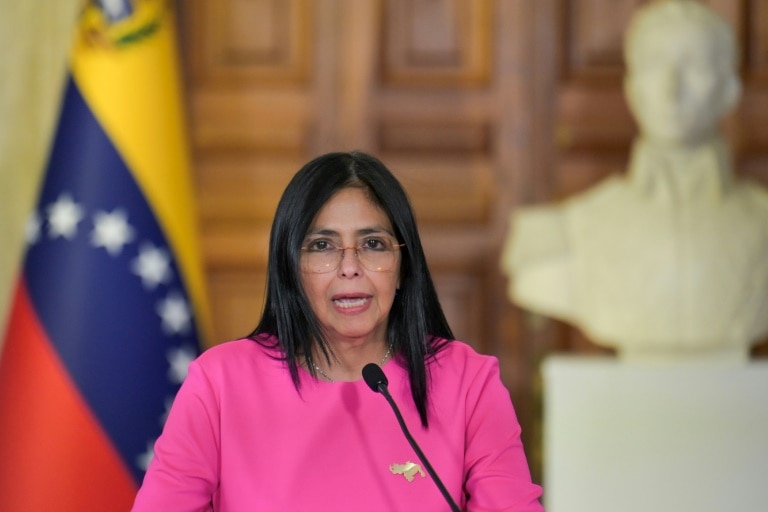
Following the dramatic capture of Nicolás Maduro by US forces, Delcy Rodríguez has ascended to the role of Acting President of Venezuela, marking an unprecedented moment as the first woman to hold executive power in the nation. The Venezuelan Supreme Court formally authorized her assumption of presidential duties in an acting capacity, a move subsequently endorsed by the country’s military establishment.
Rodríguez, a 56-year-old lawyer by training, has been a central figure in successive administrations led by both Maduro and his predecessor, Hugo Chávez. Her political trajectory includes significant roles as Foreign Minister, Vice President since 2018, and most recently, Minister of Hydrocarbons—a position of critical importance in an economy fundamentally reliant on oil exports.
Known for her staunch anti-imperialist stance and once dubbed ‘the tigress’ by Maduro himself, Rodríguez now faces the complex task of navigating Venezuela’s political transition while maintaining cohesion within the Chavista movement. Her immediate response to Maduro’s capture was to assert that he remains the ‘only president’ and to demand his unconditional release, simultaneously positioning herself as a stabilizing force.
Her political lineage is deeply intertwined with Venezuela’s socialist movement. Her brother, Jorge Rodríguez, currently leads the National Assembly, and their family history is marked by political activism—their father, a Marxist activist, died in government custody in 1976. Analysts suggest this personal history has profoundly influenced her political motivations and leadership style.
In recent years, Rodríguez demonstrated pragmatic governance by moderating her rhetoric and engaging with Venezuela’s business community—a sector historically criticized by socialist leadership. As Economy Minister from 2020 to 2024, she implemented eased trade controls and accommodated dollarization, earning cautious approval from economic stakeholders despite facing international sanctions herself for alleged democratic undermining and human rights violations.
The international response remains cautiously observant. Former US President Donald Trump indicated that Rodríguez had expressed willingness to collaborate with Washington, though he issued stern warnings should she fail to meet US demands regarding policy reforms and oil access. Secretary of State Marco Rubio stated that the US would evaluate potential cooperation based on actions rather than declarations, explicitly downplaying the prospects of opposition leader María Corina Machado.
Political analysts note that while Rodríguez requires formal swearing-in, she effectively operates as de facto president. Her challenge lies in balancing internal party expectations, international pressures, and the management of the world’s largest proven oil reserves amidst profound national and geopolitical uncertainty.