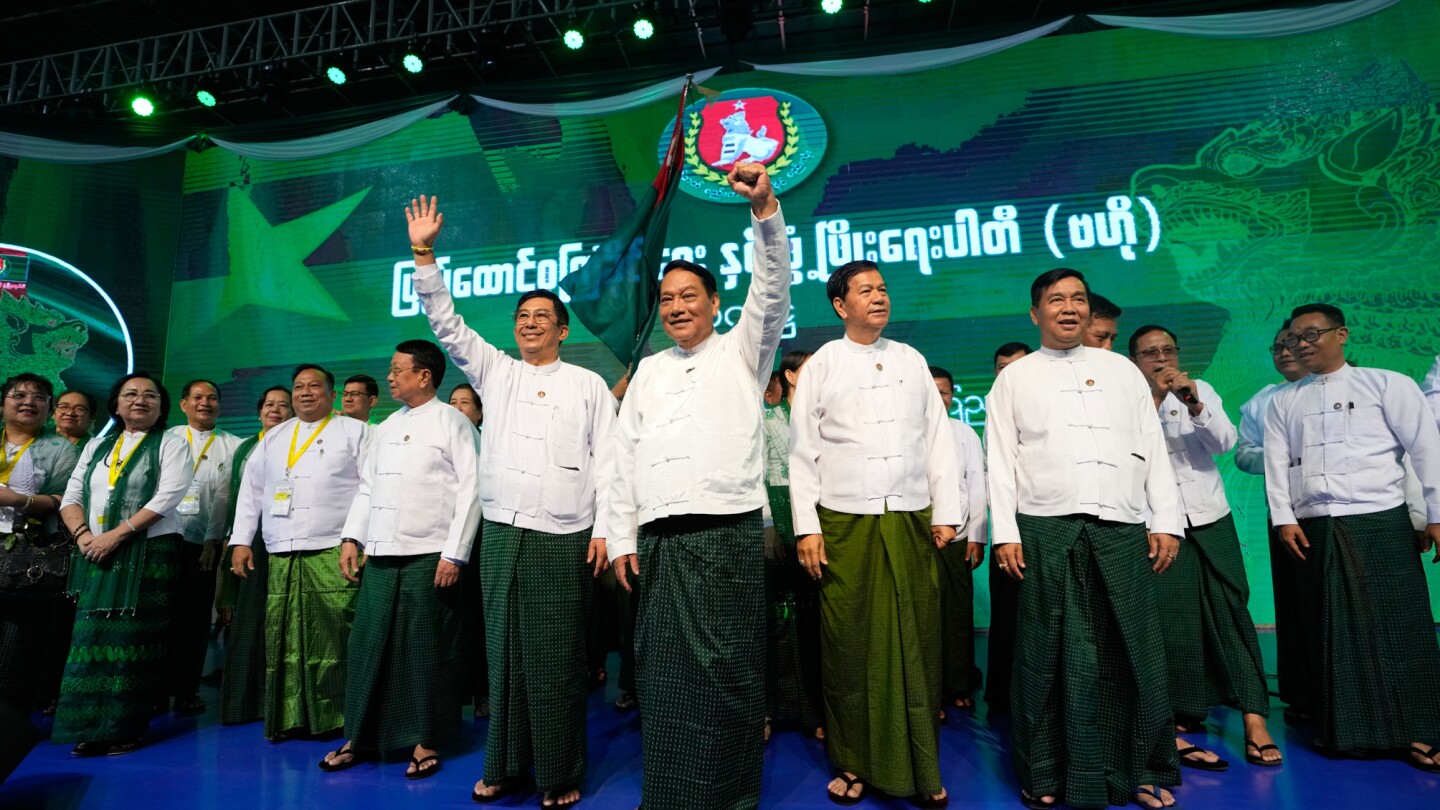
BANGKOK (AP) — Myanmar’s military-appointed electoral authority has commenced announcing results from the initial stage of its three-phase general election, confirming widespread expectations that the junta-supported Union Solidarity and Development Party (USDP) has secured most declared seats.
The electoral process, criticized by opposition groups as fundamentally flawed, faces allegations of being engineered to provide superficial legitimacy to military rule. Detractors emphasize the exclusion of major political factions and systematic suppression of dissent as evidence that the polls lack both freedom and fairness. Numerous opposition organizations have consequently advocated for voter boycotts.
According to Wednesday’s government statement, approximately 52% of eligible voters—over 6 million individuals—participated in the December 28 first-phase elections, which the regime characterized as a resounding success.
Saturday’s partial results published in the state-controlled Myanma Alinn newspaper revealed the USDP secured 38 seats in the 330-member Pyithu Hluttaw lower house, with numerous constituencies still awaiting declaration. A separate announcement confirmed USDP leader Khin Yi, former general and police chief regarded as a key ally of military ruler Senior General Min Aung Hlaing, won his Naypyitaw constituency with 49,006 of 68,681 votes.
The Shan Nationalities Democratic Party and Mon Unity Party each gained one seat according to the Union Election Commission’s statement.
Despite incomplete results, USDP leadership expressed confidence in their first-phase performance. A senior party official anonymously informed The Associated Press they had captured 88 of 102 contested seats, noting the party faced no opposition in 29 constituencies due to absent challengers.
Myanmar’s political structure features a bicameral national legislature totaling 664 seats. The constitution guarantees the military 25% automatic representation in each chamber, meaning any party seeking governance must achieve a combined parliamentary majority to select the president and form a government.
The USDP official additionally claimed victory in 85% of regional legislature contests, though complete outcomes await subsequent voting phases scheduled for January 11 and 25. Electoral proceedings occur in三个阶段 due to ongoing armed conflicts, with 65 townships excluded entirely from participation.
While 57 parties fielded over 4,800 candidates for national and regional legislatures, only six organizations possess nationwide reach and potential parliamentary influence, with the USDP emerging as the dominant force.
The current military regime originated from the February 2021 coup that ousted Aung San Suu Kyi’s democratically elected government, preventing her National League for Democracy (NLD) from serving a second term despite their landslide 2020 victory. The NLD was subsequently dissolved in 2023 alongside 39 other parties for refusing registration under new military regulations. The takeover ignited widespread resistance that has since evolved into full-scale civil war.