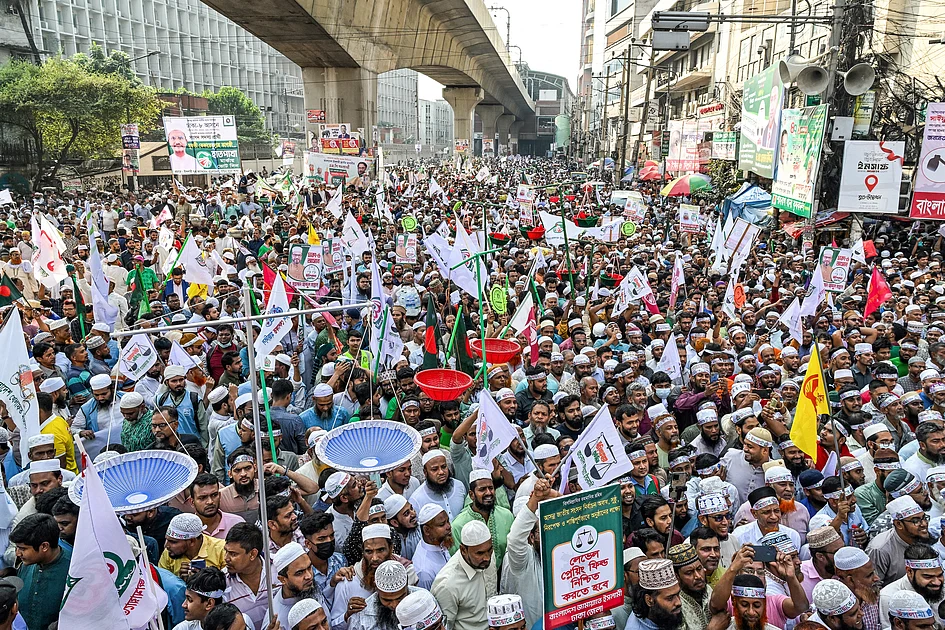
In a significant development within Bangladesh’s political landscape, the historically banned Jamaat-e-Islami party has expressed willingness to participate in a unity government following February’s parliamentary elections. Party President Shafiqur Rahman confirmed in an exclusive Reuters interview that his organization has engaged in preliminary discussions with multiple political factions ahead of the February 12 vote.
Current polling data indicates Jamaat-e-Islami is positioned to achieve its strongest electoral performance in nearly two decades, potentially finishing as runner-up to the Bangladesh Nationalist Party (BNP). This represents a remarkable political resurgence for the Islamist party, which regained electoral eligibility in August 2024 when an interim government led by Nobel laureate Muhammad Yunus lifted long-standing restrictions.
The party’s political rehabilitation follows the dramatic ousting of former Prime Minister Sheikh Hasina during youth-led demonstrations in August 2024. Hasina’s Awami League party, which had maintained a consistently adversarial relationship with Jamaat-e-Islami, remains barred from participating in the upcoming election.
Rahman emphasized that any unity government must prioritize anti-corruption measures as a shared objective. While advocating for Islamic governance under sharia law, the party leadership has simultaneously sought to broaden its appeal beyond traditional conservative constituencies. The Jamaat president clarified that the prime ministerial position would naturally be claimed by whichever party secures the most parliamentary seats.
Regarding international relations, Rahman addressed Bangladesh’s complex diplomatic landscape. He expressed concerns about former Prime Minister Hasina’s continued residence in India since her departure from Dhaka, noting that bilateral relations have deteriorated significantly since her administration’s collapse. The party leader confirmed a confidential meeting with an Indian diplomat earlier this year, contrasting this discreet engagement with more transparent interactions with other international representatives.
When questioned about historical ties to Pakistan, Rahman asserted Jamaat-e-Islami’s commitment to balanced international relations: “We maintain relations in a balanced way with all. We are never interested in leaning toward any one country.”
The party leader further indicated that any government including Jamaat-e-Islami would experience discomfort with current President Mohammed Shahabuddin, who was elected unopposed with Awami League support in 2023. The ceremonial head of state previously told Reuters he would consider stepping down before completing his term.