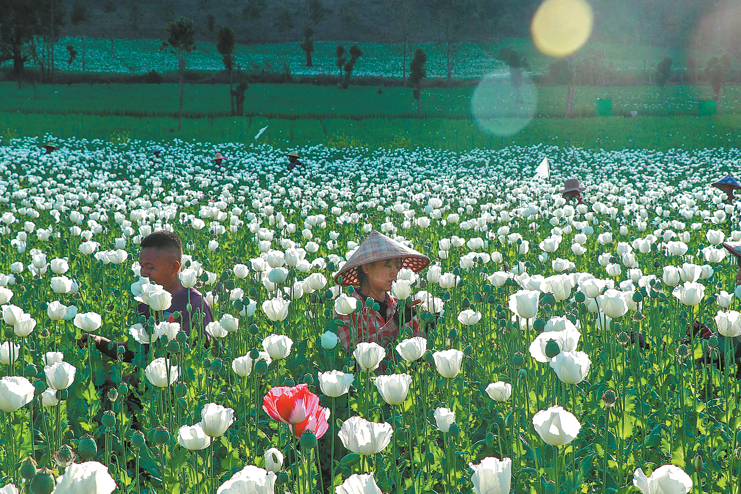
Myanmar has dramatically escalated to become the globe’s foremost opium producer, with cultivation reaching a ten-year peak according to the United Nations Office on Drugs and Crime (UNODC). The Southeast Asian nation’s opium output now more than doubles that of Afghanistan, the previous leading source.
Recent UNODC data reveals a striking 17% year-on-year surge in Myanmar’s opium cultivation, expanding from 45,200 hectares to 53,100 hectares. This expansion solidifies Myanmar’s notorious status as a primary source of illicit opium globally, particularly as Afghan production continues its downward trajectory.
Delphine Schantz, UNODC’s Regional Representative for Southeast Asia and the Pacific, warned that “the sharp increase in opium cultivation demonstrates an expanding opium economy that has been resurgent in recent years and is likely to grow further.”
The agency attributes this alarming growth primarily to skyrocketing opium prices, which have more than doubled from $145 per kilogram in 2019 to the current $329 per kilogram. This economic incentive, combined with escalating conflict and instability throughout Myanmar, has driven many farmers toward poppy cultivation as a means of survival.
Regional analysis shows eastern Shan State experienced the most dramatic growth at 32%, followed by Chin State at 26%, while Kachin State saw a modest 3% increase. Southern Shan State remains the cultivation epicenter, accounting for 44% of the country’s total opium production.
For the first time, the UNODC study documented significant opium cultivation in Sagaing Region, estimating 552 hectares under poppy production. There are also emerging indications that Myanmar’s opium is increasingly supplanting Afghan supplies in international markets, with European authorities reporting seizures of heroin believed to originate from Myanmar on flights from Thailand.