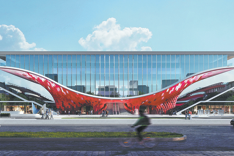
In a groundbreaking development for sustainable architecture, China’s Xiong’an New Area has unveiled what experts are calling a paradigm-shifting model for future urban construction. The Xiong’an Wings cultural center, now standing as one of the world’s largest 3D-printed structures, represents a fusion of advanced manufacturing, ecological design, and digital innovation.
Soaring five stories high with dramatic 20-meter cantilevered roofs that emulate a swan in flight, the building’s design draws inspiration from classical Chinese poetry depicting waterfowl gliding over misty landscapes. This artistic vision presented significant engineering challenges that conventional construction methods couldn’t economically solve, particularly for the complex double-curved facade.
Project Technical Director Zhang Xihuang explained how 3D printing technology enabled the realization of this ambitious design: ‘We utilized modified plastic panels manufactured with precision layering to create the flowing red wings that define the structure. This approach not only achieved our aesthetic objectives but also demonstrated substantial environmental advantages.’
The construction methodology reduced material consumption by 20-30% and completely eliminated the need for polluting molds, addressing waste reduction at its source. Durability testing indicates the printed panels will maintain over 80% of their performance characteristics after two decades of outdoor exposure.
The project implemented a fully digital workflow utilizing Building Information Modeling (BIM) throughout its entire lifecycle, from initial design to future operational management. On-site construction was monitored by drone-mounted laser scanners that detected deviations as slight as five centimeters, enabling real-time adjustments.
Structural efficiency was further enhanced through topology optimization software that minimized unnecessary steel in the building’s frame without compromising strength. Once operational, the center’s advanced insulation and intelligent management systems are projected to reduce annual energy consumption by more than 30%.
The cultural center, developed through collaboration between Power Construction Corporation of China and Tongji University researchers led by Professor Yuan Feng, will serve as a community hub featuring performance spaces for opera, music, and conferences. Its extensive glass walls offer panoramic views of Jinhu Lake, integrating the natural surroundings with indoor activities.
Perhaps most significantly, the project’s innovations are being formalized into Xiong’an’s first local technical standards for 3D-printing construction technology, creating a replicable template for future sustainable development. Zhang characterized Xiong’an Wings as ‘a convincing example of how cities can be built smarter, greener and more beautifully for the future.’