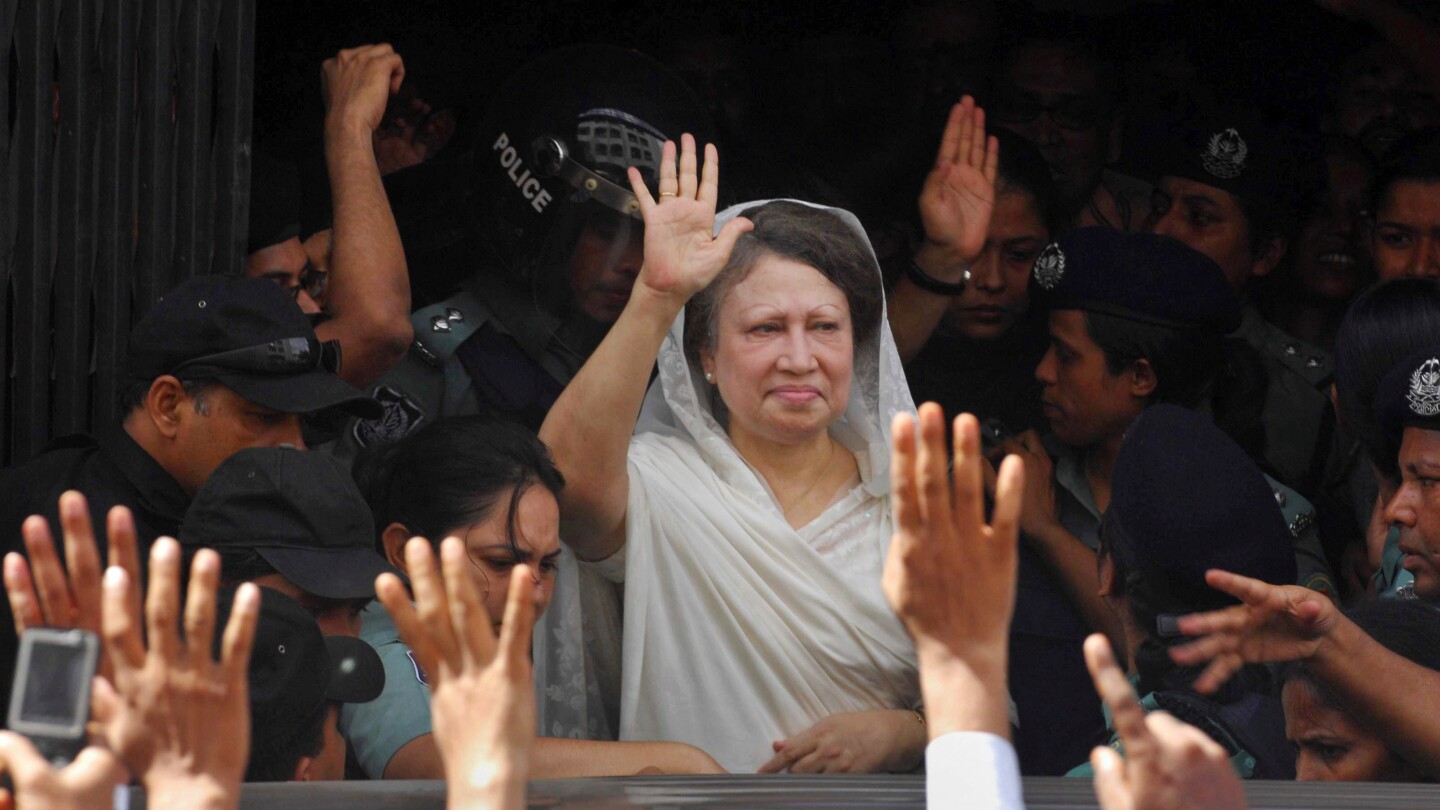
DHAKA, Bangladesh — Khaleda Zia, Bangladesh’s pioneering female prime minister whose decades-long political rivalry with Sheikh Hasina shaped the nation’s democratic trajectory, has passed away at age 80. Her Bangladesh Nationalist Party (BNP) confirmed her death in an official statement Tuesday.
Zia’s political journey witnessed extraordinary highs and devastating lows, culminating in a dramatic final chapter that saw her recently acquitted of corruption charges by the Supreme Court in January 2025. This judicial clearance would have permitted her participation in February’s general elections, marking a potential political resurgence after years of legal battles she maintained were politically motivated.
The former leader’s health struggles became a focal point in her later years. Following her 2020 release from prison on medical grounds, her family submitted at least 18 formal requests to the Hasina administration seeking permission for international medical treatment—all systematically denied. The political landscape shifted dramatically with Hasina’s ouster in the 2024 mass uprising, enabling an interim government headed by Nobel laureate Muhammad Yunus to finally authorize Zia’s medical transfer to London in January. She returned to Bangladesh in May 2025.
Zia’s political legacy is inextricably linked to Bangladesh’s turbulent post-independence era. Her husband, President Ziaur Rahman, assumed power in 1977 and established the BNP the following year. Following his assassination in a 1981 military coup, Zia emerged as a formidable force against military dictatorship, ultimately contributing to the overthrow of dictator H.M. Ershad in 1990.
Her electoral victories in 1991 and 2001 positioned her in direct competition with Hasina, daughter of independence leader Sheikh Mujibur Rahman. Zia’s second term (2001-2006) proved particularly controversial due to her coalition with the Islamist Jamaat-e-Islami party and allegations that her elder son Tarique Rahman operated a parallel government engaged in widespread corruption.
The bitter rivalry between Zia and Hasina intensified following the 2004 grenade attacks in Dhaka that killed 24 Awami League members, which Hasina blamed on Zia’s government. Subsequent years saw Zia imprisoned on corruption charges, boycotts of elections, and ultimately Hasina’s extended tenure until the 2024 uprising.
Despite withdrawing from public political activities in her final years, Zia remained the BNP’s official chairperson until her death, with her son Tarique Rahman serving as acting chair since 2018. Her last public appearance occurred at a November military function where she appeared frail in a wheelchair.
Zia’s passing marks the end of an era in Bangladeshi politics, leaving behind a complex legacy as both a groundbreaking female leader and a polarizing political figure whose life mirrored the nation’s tumultuous democratic evolution.