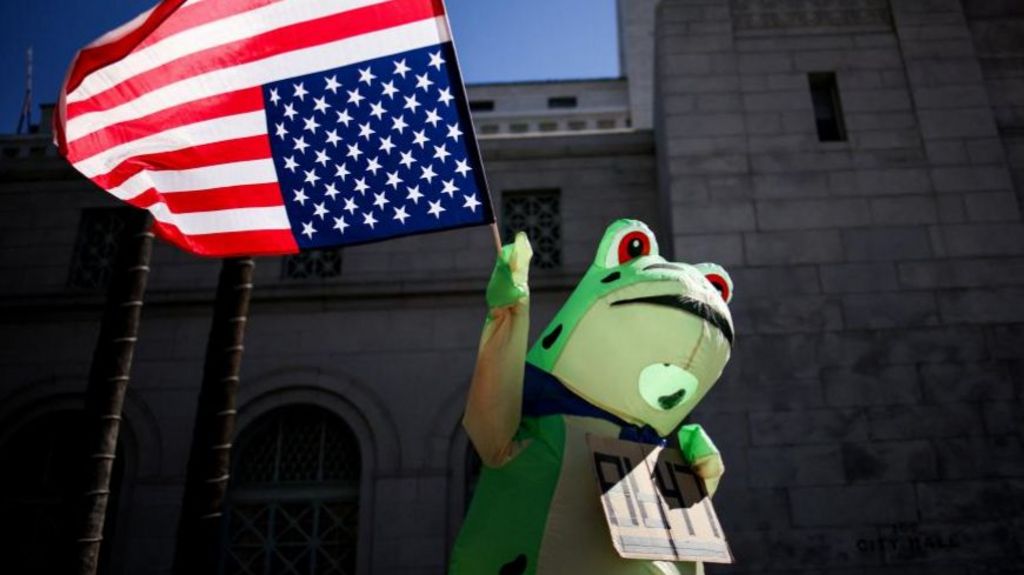
In an extraordinary display of political theater, American protest movements have embraced absurdist costuming as strategic resistance. The phenomenon reached viral prominence in October when immigration agents in Portland sprayed crowd control chemicals into the protruding snout of an activist’s inflatable frog costume—an image that quickly symbolized the escalating tensions between demonstrators and federal authorities.
This incident catalyzed the transformation of amphibian imagery from far-right symbol to left-wing protest icon. The frog costume, initially spotted in Portland’s quirky protest culture, has since proliferated across demonstrations from San Diego to Boston, and internationally in Tokyo and London. The unexpected adoption represents a remarkable reclamation of symbolic imagery in America’s political landscape.
Professor LM Bogad of UC Davis, a Guggenheim Fellow specializing in performance art, identifies this as ‘tactical frivolity’—a calculated strategy using humor to challenge authority. ‘It makes it look worse if you respond with violence to someone in a ridiculous costume,’ Bogad explains, noting how absurd imagery creates ‘irresistible’ visual narratives that disarm opponents while attracting media attention.
The frog’s political journey traces back to Pepe, a cartoon character created by artist Matt Furie that was co-opted by alt-right communities during the 2016 election. Once deployed as a symbol by white supremacists and notably retweeted by Donald Trump himself, Pepe’s association with extremism prompted Furie to attempt reclaiming his creation through legal battles and even killing off the character in comics.
Portland’s protest culture, with its unofficial motto ‘Keep Portland Weird,’ provided fertile ground for symbolic transformation. The city’s tradition of eccentric demonstrations—featuring nude cyclists, public yoga, and 80s-style aerobics—created an environment where inflatable dinosaurs, unicorns, and axolotls join frogs as instruments of political theater.
Operation Inflation, a Portland-based collective, has institutionalized this approach by distributing over 350 inflatable costumes to protesters nationwide. Co-founder Brooks Brown draws parallels to Civil Rights Era strategies: ‘Our job is to build a different stage, and to force them onto ours.’ The group explicitly aims to counter the administration’s narrative of protesters as violent mobs through deliberate absurdity.
This methodology extends beyond American borders, resembling tactics used by Serbia’s Otpor movement against Milosevic and the coded use of Winnie the Pooh imagery by critics of Xi Jinping. As Bogad notes: ‘Authoritarians don’t like to be laughed at. Without even giving a speech, you are undermining the authoritarian script.’
The legal system has taken note: a federal judge’s dissenting opinion specifically referenced protesters’ ‘well-known penchant for wearing chicken suits, inflatable frog costumes, or nothing at all’ when challenging the characterization of Portland as a ‘war zone.’
What emerges is a sophisticated understanding of symbolic warfare in the digital age—where memes become battlegrounds, costumes become rhetorical devices, and the most effective resistance might just come wearing webbed feet and bulging eyes.