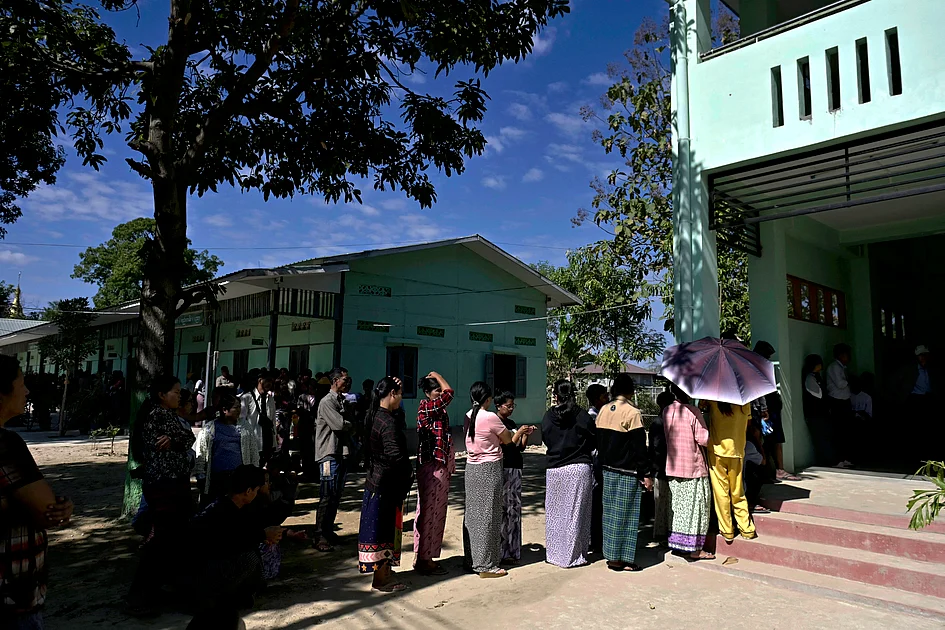
Myanmar’s military regime conducted a heavily controlled electoral exercise on Sunday, presenting the event as a democratic transition five years after seizing power in a coup that plunged the nation into civil war. The voting process unfolded under intense international scrutiny and widespread domestic skepticism.
With former civilian leader Aung San Suu Kyi serving a 27-year prison sentence and her National League for Democracy party dissolved, the electoral landscape has been fundamentally reshaped. The Union Solidarity and Development Party, aligned with military interests, stands as the anticipated victor in what critics characterize as an attempt to legitimize continued authoritarian rule.
Junta chief Min Aung Hlaing asserted the election’s credibility during his ballot casting in Naypyidaw, stating, “We guarantee it to be a free and fair election. It’s organized by the military, we can’t let our name be tarnished.”
The reality on ground reveals a different picture. Voting was impossible across substantial territories controlled by ethnic rebel factions challenging military authority. In Yangon polling stations, journalists and election staff frequently outnumbered the sparse trickle of voters during early hours—a stark contrast to the enthusiastic queues witnessed during the 2020 elections that prompted the military’s power grab.
The United Nations human rights chief Volker Turk condemned the process, noting it occurs within “an environment of violence and repression.” The junta has pursued legal actions against over 200 individuals under legislation prohibiting election criticism or disruption.
Technical aspects of the voting process further raised concerns, as new electronic machines prevent write-in candidates or ballot spoiling. The military administration has acknowledged that elections cannot proceed in nearly 20% of lower house constituencies due to security concerns.
The phased election will continue with additional rounds scheduled over the coming weeks, though many displaced citizens and international observers remain skeptical about its potential to restore stability or democratic governance to the conflict-ravaged nation.