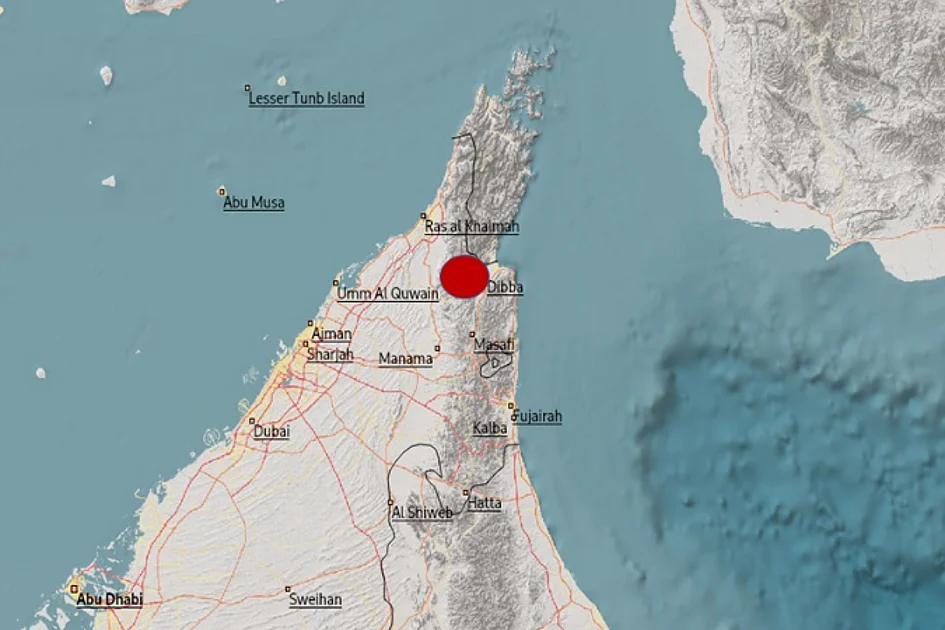
A minor seismic event measuring 2.9 magnitude struck southern Musandam in the early hours of Sunday, December 28, 2025, according to official reports from the National Centre of Meteorology’s Seismic Network. The tremor occurred at precisely 4:44 AM UAE local time at a shallow depth of approximately 5 kilometers.
The earthquake generated subtle vibrations that were faintly perceptible to residents across certain parts of the United Arab Emirates, though the National Centre of Meteorology confirmed the event produced no measurable impact within the country’s territory. This incident represents the latest in a series of minor seismic activities affecting the strategically significant Musandam region.
Geographically positioned south of the critical Strait of Hormuz, the Musandam peninsula exists under a unique jurisdictional arrangement. While predominantly administered by Oman as the Musandam Governorate, certain segments fall under UAE authority, including areas within Ras Al Khaimah and sections of Dibba.
Seismological experts attribute the occasional tremors felt in the UAE to the nation’s proximity to the Zagros mountain range—recognized globally as one of the most seismically active zones. This geological feature, extending through Iran and Iraq, frequently generates seismic events that sometimes produce detectable vibrations hundreds of kilometers away, particularly in the Northern Emirates.
The recent Musandam event follows multiple similar occurrences throughout the region in recent months. On November 4, 2025, a 4.6 magnitude quake struck southern Musandam, with tremors similarly detected in the Emirates. Additional seismic activity was recorded in Saudi Arabia (December 17, magnitude 4.3), Bahrain (December 1, magnitude 3.3), and Iraq (November 22, magnitude 5.0), though none produced impacts within the UAE.
According to Mohamed Alhassani, acting head of the Seismic Monitoring Section at the National Centre of Meteorology, while the UAE itself doesn’t sit within a major earthquake zone, its geographical positioning makes it susceptible to feeling distant seismic events originating from the active Zagros region.