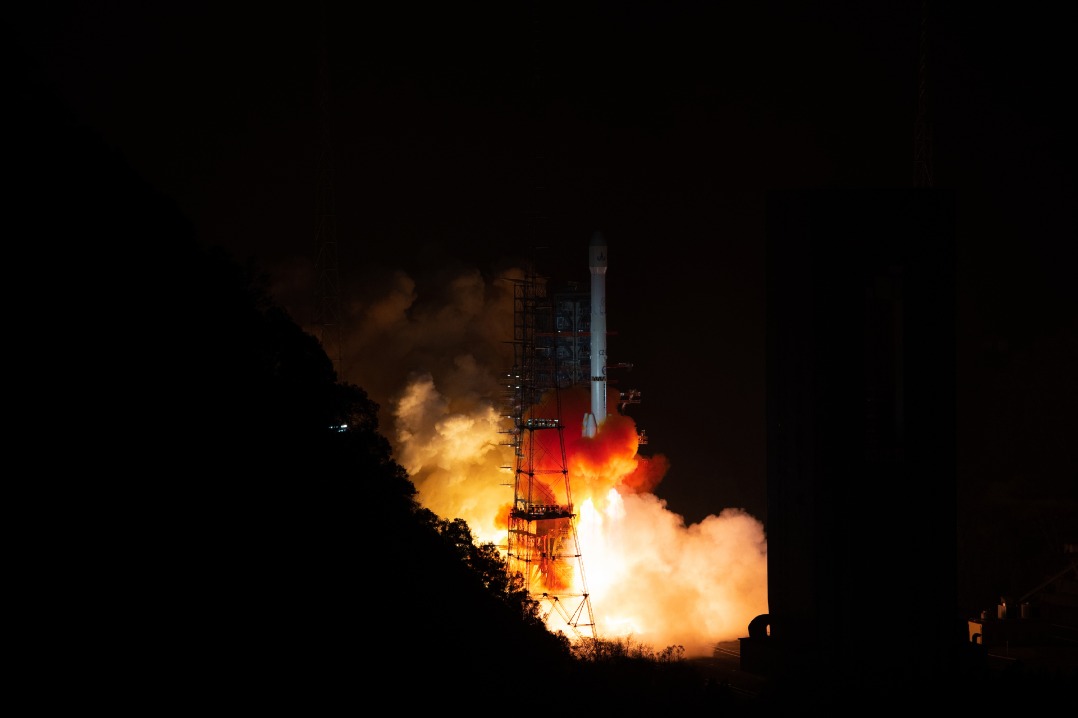
China has significantly advanced its meteorological surveillance capabilities with the successful deployment of the Fengyun-4C satellite, launched December 27, 2025 from the Xichang Satellite Launch Center in Sichuan province. The state-of-the-art geostationary satellite ascended aboard a Long March 3B carrier rocket at 12:07 AM, marking a substantial upgrade to China’s weather monitoring infrastructure.
As the newest addition to China’s second-generation Fengyun-4 series, the 4C model will assume the operational duties of the aging Fengyun-4A satellite while forming an enhanced observational network with the Fengyun-4B. The satellite’s advanced technological specifications represent what project chief commander Cao Xiaozhong describes as “a comprehensive leap in observational performance” that will substantially strengthen early warning systems for extreme weather events.
The Fengyun-4C is equipped with six cutting-edge payloads meeting international advanced standards, specifically engineered to detect small and medium-scale weather systems that frequently trigger sudden severe storms. Its geostationary radiation imager can complete full scans of China and surrounding territories every five minutes, while performing targeted regional imaging at one-minute intervals—enabling meteorologists to monitor storm evolution in near real-time.
Notable technical enhancements include the interferometric vertical atmospheric sounder, which has achieved improved spatial resolution from 12 kilometers to 8 kilometers. This instrument conducts routine hourly observations and intensified 15-minute interval monitoring, providing critical data for numerical weather prediction and typhoon forecasting. The satellite also features uninterrupted full-domain lightning monitoring to support severe convection warnings.
Beyond terrestrial applications, the Fengyun-4C carries advanced space weather monitoring instruments capable of detecting solar proton events and other space weather disturbances. Positioned at 133 degrees east longitude, the satellite extends China’s monitoring reach into the central Pacific Ocean, particularly strengthening surveillance of typhoon genesis regions in the Western Pacific.
China’s meteorological satellite network now comprises 23 Fengyun satellites with 10 currently operational, providing data services to 133 countries and regions. The system serves as the core infrastructure for MAZU, China’s AI-powered meteorological early warning platform launched earlier this year.