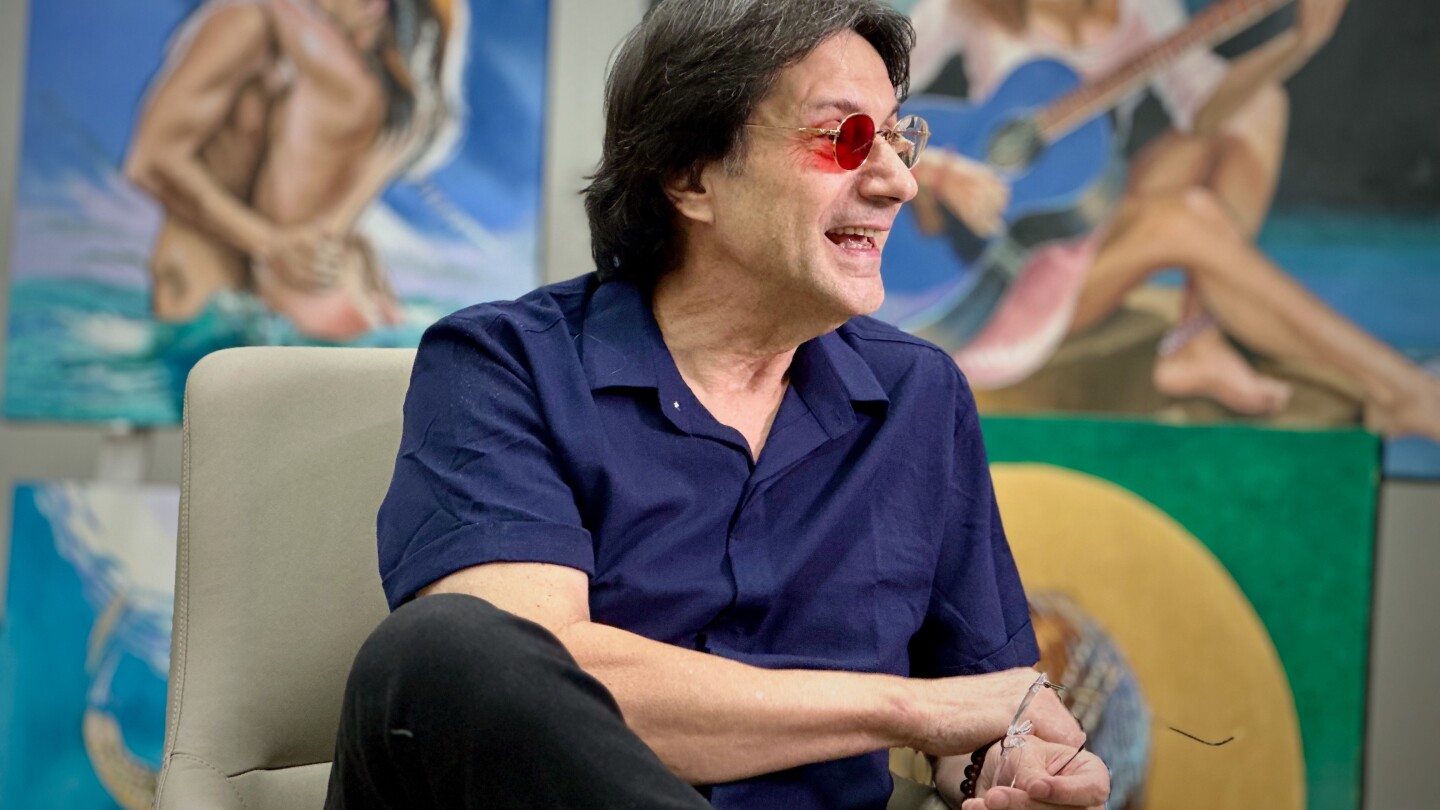
DORAL, Fla. (AP) — Colombian-born artist Fernando Dávila’s artistic journey began with an early setback—failing a childhood drawing class in Colombia for painting donkeys red. This unconventional color choice stemmed from a biological reality: Dávila is colorblind. Now at 72, the internationally acclaimed painter creates vibrant works exhibited across three continents, transforming his visual limitation into artistic triumph.
From his Miami studio, Dávila reflects: “I possess the world’s most wonderful occupation—painting each morning. Blending colors and sharing joy with the world constitutes my true passion.” His artistic practice initially confined itself to monochromatic works until age thirty due to his congenital condition that impairs differentiation between red and green hues, along with confusing pink, violet, turquoise, and yellow-green shades.
A transformative development occurred in the mid-1980s when a New York ophthalmologist designed specialized glasses featuring one transparent lens and one red-tinted lens. This optical innovation enables Dávila to distinguish contrasting shades that typically blur together, expanding his color perception from 40% without aids to nearly two-thirds of the color spectrum.
Dávila metaphorically describes his experience as “having a chocolate box while only sampling portions.” He expresses profound yearning to experience full chromatic richness: “When someone mentions a vividly pink flower, I passionately desire to perceive it—this longing emanates from my heart. I sense color’s vibration.”
The genetic condition spans his family lineage, affecting his grandfather (monochromatic vision), mother, three aunts, and two brothers—notable given colorblindness’s lower prevalence among females. Despite these visual constraints, Dávila’s distinguished career spanning Colombia, New York, and Florida earned him the Colombian Congress’s “Order of Democracy” in 1999 for artistic contributions.
The established artist has published two hardcover books and numerous exhibition catalogues, with his works appearing at premier auction houses Christie’s and Sotheby’s. His paintings frequently feature romantic human embraces and landscapes, often employing blue as foundational hue. “Color remains life’s essential element,” Dávila concludes, “particularly for myself.”