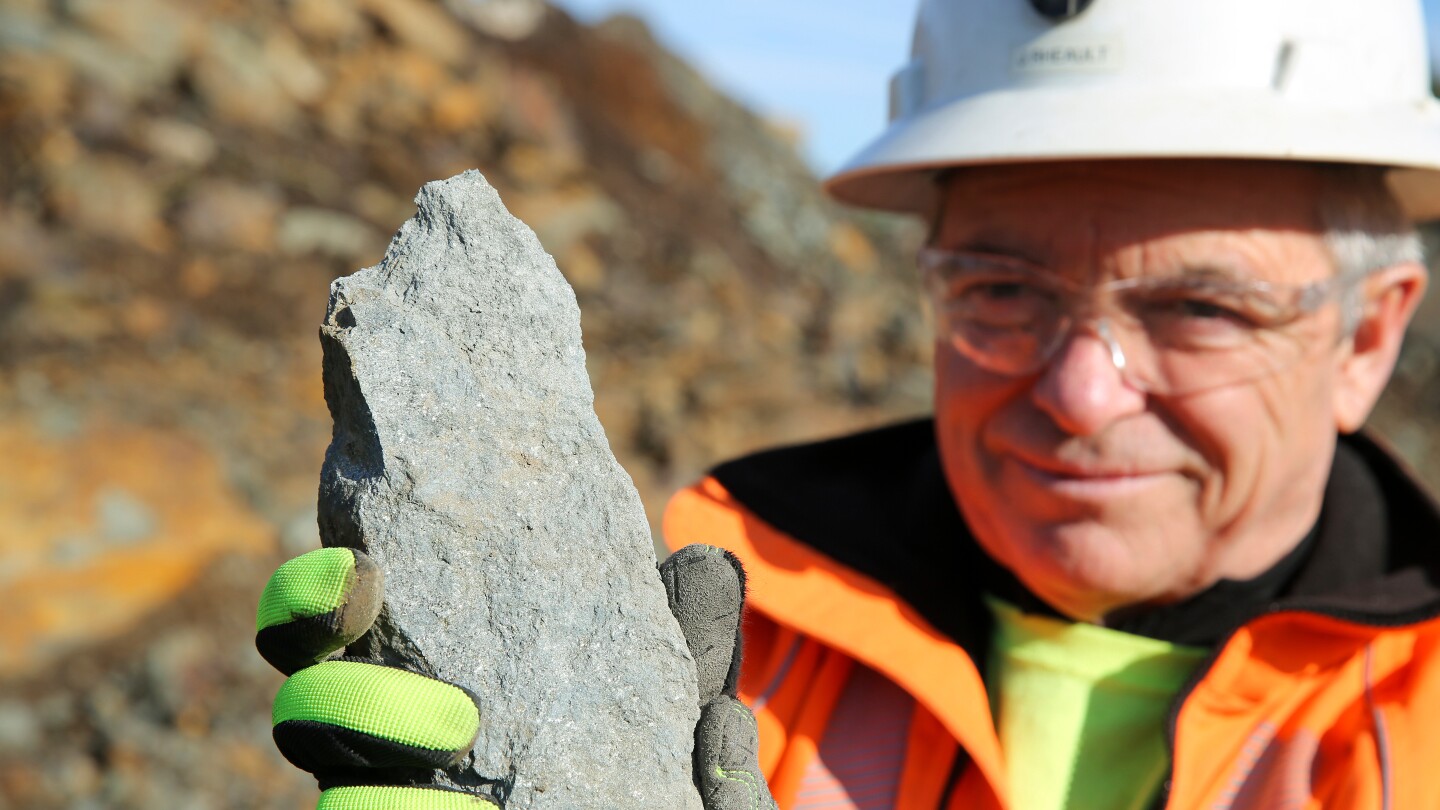
GOUVERNEUR, N.Y. — After seven decades of dormancy, America’s graphite mining industry is experiencing a remarkable resurgence driven by geopolitical tensions and soaring demand for battery materials. This strategic shift comes as trade uncertainties with China prompt federal officials to prioritize domestic production of critical minerals essential for high-tech and defense applications.
Titan Mining Corp. has initiated limited operations at a northern New York deposit located 25 miles from the Canadian border, targeting commercial graphite production by 2028. Company executives believe current geopolitical dynamics favor domestic sourcing for military vehicle lubricants, industrial heat-resistant coatings, and lithium-ion battery components for grid storage systems.
CEO Rita Adiani emphasized the strategic imperative: “We possess the capability to supply a substantial percentage of U.S. graphite requirements, particularly given China’s increasingly unreliable supply chain status.”
The revival occurs against a backdrop of heightened trade tensions during the Trump administration, though some pressures eased following the October meeting between President Trump and China’s Xi Jinping at a regional economic summit in South Korea.
New York’s mining region boasts a rich industrial heritage, historically producing graphite for iconic products like Ticonderoga pencils. Titan’s operational advantage stems from discovering graphite deposits at their existing zinc mine site, allowing immediate limited extraction under current permits while pursuing full-scale mining authorization.
Graphite’s classification as a critical mineral stems from its exceptional electrical conductivity and thermal resistance properties. The Department of Energy and Interior recognize its strategic importance, listing it among 60 crucial minerals alongside rare earth elements. Global demand is projected to skyrocket over the next decade, encompassing both natural mined graphite and purer synthetic alternatives for lithium-ion battery anodes.
Federal support mechanisms include tax credits under the 2022 Inflation Reduction Act and streamlined permitting processes. The Export-Import Bank is considering $120 million in construction financing alongside a $5.5 million feasibility study grant for Titan’s project, which received fast-tracked federal approval this fall.
Currently, no U.S. mines regularly produce commercial graphite, but five active projects—in New York, Alabama, Montana, and Alaska—aim to change this. Graphite One’s Alaska operation reportedly sits atop the nation’s largest known flake graphite deposit.
Anthony Huston, Graphite One’s CEO, captured the industry sentiment: “With one of Earth’s largest graphite deposits domestically available, Chinese dependence becomes unnecessary.” Titan anticipates producing 40,000 metric tonnes annually, potentially covering half of America’s natural graphite requirements, with indications suggesting complete output absorption by the market.