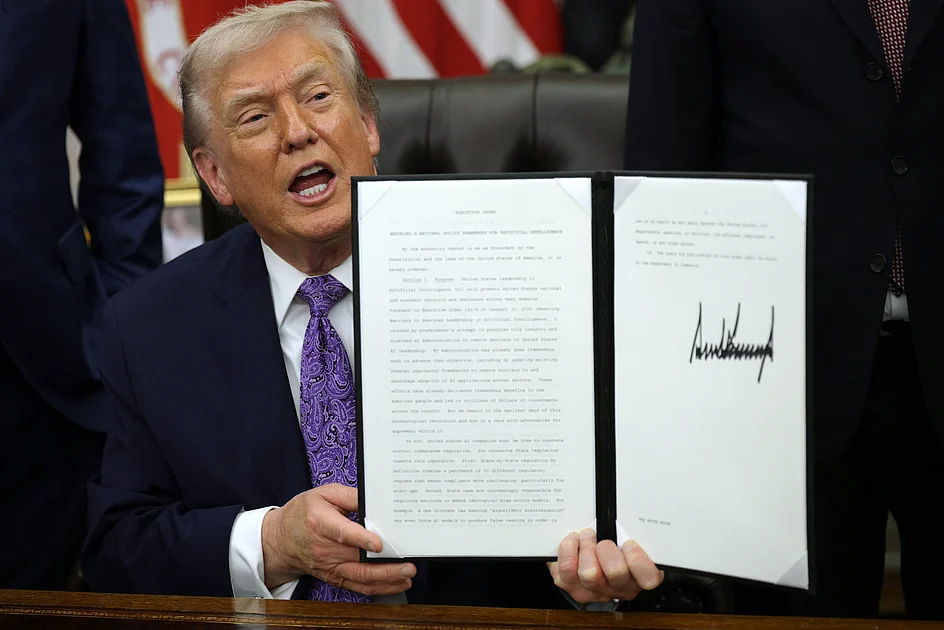
In an extraordinary demonstration of presidential authority, Donald Trump has now signed more executive orders during his current term’s first year than throughout his entire previous presidency. The 221st executive order, designating fentanyl as a weapon of mass destruction, marks the latest in a rapid succession of presidential directives that analysts describe as one of the most significant displays of executive power in modern American history.
According to Federal Register data analyzed by AFP, Trump’s current pace of executive actions exceeds the annual averages of his immediate predecessors—Joe Biden, Barack Obama, and George W. Bush—by approximately five to seven times. Only Franklin D. Roosevelt, who governed during the Great Depression and World War II, maintained a comparable rate of executive orders across his four terms.
Political science professor John Woolley of the University of California, Santa Barbara, characterizes these orders as strategic communication tools. “They serve as signals to crucial constituent groups that the administration is actively advancing their causes,” noted Woolley, who co-directs the American Presidency Project.
An analysis of the orders reveals distinctive patterns: nearly 60% address domestic matters, while fewer than 10% focus exclusively on foreign policy. Social issues—encompassing culture, civil rights, education, and health—constitute approximately 30% of all orders, surpassing economic matters (20%) and government reform (18%). Immigration and security, central to Trump’s 2024 campaign, account for roughly 10%.
The content frequently reflects ideological positions, including an July directive prohibiting AI models that emphasize diversity and inclusion, and an August order establishing classical architecture as the preferred style for federal buildings.
However, the efficiency of governing through executive orders remains questionable. Just Security, a legal analysis website affiliated with New York University, reports that over 20% of Trump’s orders have faced legal challenges, with more than 20 being partially or fully blocked by courts. Recent appellate rulings have deemed significant portions of Trump’s tariff policies illegal, and the Supreme Court has shown skepticism regarding the legality of certain trade measures during November hearings.
Despite these challenges, Woolley suggests Trump is deliberately testing legal boundaries: “He’s wagering that the Supreme Court, with its conservative majority strengthened during his first term, will largely endorse his interpretation of executive power.”
The language within these orders also distinguishes Trump’s approach. Analysis reveals he employs the verb “impose” five times more frequently than his predecessors and references the “nation” and “American people” at notably higher rates. Additionally, over 15% of orders contain elements of political retaliation, explicitly criticizing previous administrations and opponents—a departure from historical norms according to presidential scholars.