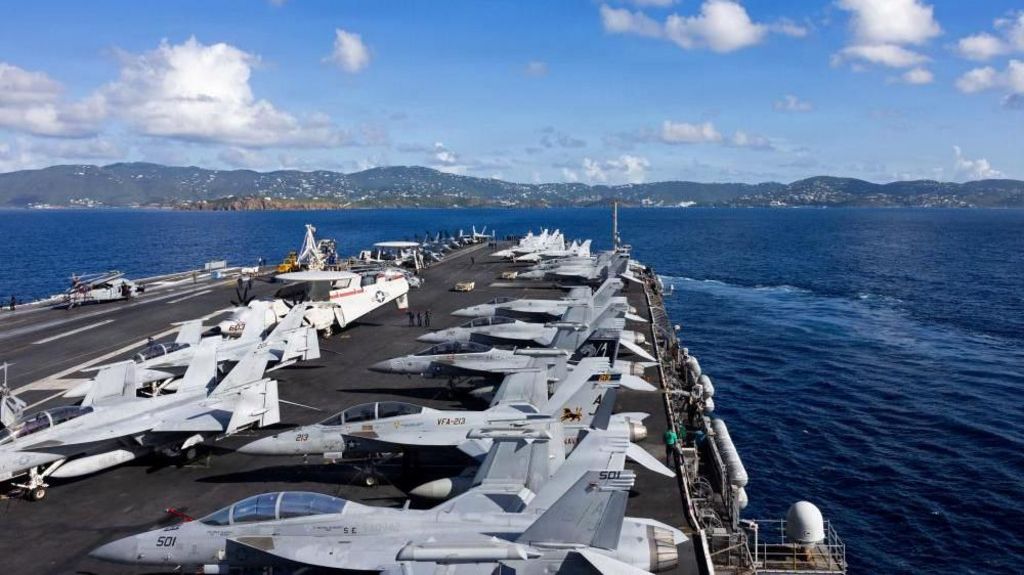
The Caribbean Sea is witnessing its most significant US military deployment since the Cold War’s conclusion, with the nuclear-powered USS Gerald Ford aircraft carrier leading a formidable naval presence. This strategic mobilization responds to escalating tensions between Washington and Caracas, drawing inevitable comparisons to the 1989 US invasion of Panama that ousted President Manuel Noriega.
The historical parallel emerges from strikingly similar circumstances: both episodes feature Latin American leaders accused by Washington of direct involvement in narcotics trafficking, both involve years of accumulated diplomatic enmity, and both concern nations possessing immense strategic value—Panama with its critical canal and Venezuela with its vast oil reserves.
Yet the distinctions between these two moments reveal evolving geopolitical realities. The 1989 operation against Noriega occurred within a Cold War context, with concrete evidence presented through financial records and cartel testimonies. Current allegations against President Nicolás Maduro center on what US officials term the ‘Cartel of the Suns’—an alleged network of current and former Venezuelan military officials that some drug policy analysts question as a formally structured organization.
The legal justification has similarly evolved. Where the Panama intervention followed the shooting death of US Marine Lieutenant Robert Paz at a checkpoint, the current administration employs the concept of ‘narco-terrorism’ to characterize its operations against drug-smuggling vessels in international waters. This approach has sparked controversy regarding international law interpretations, particularly after a September incident where a follow-up airstrike killed two survivors from an initial engagement.
Adding complexity to the situation, the Trump administration has imposed fresh sanctions on three of Maduro’s nephews, including two previously convicted in the 2015 ‘narco-nephews’ cocaine smuggling case. Venezuelan officials vehemently deny all allegations, with Interior Minister Diosdado Cabello dismissing the Cartel of the Suns as ‘an imperialist invention.’
With US forces having already seized a tanker carrying Venezuelan crude and controlling air and sea approaches to Venezuela, analysts note that the situation remains highly volatile. As demonstrated in Panama, such military buildups can be triggered into full-scale conflict by a single incident, making the current Caribbean standoff one of the most dangerously unpredictable geopolitical situations in recent decades.