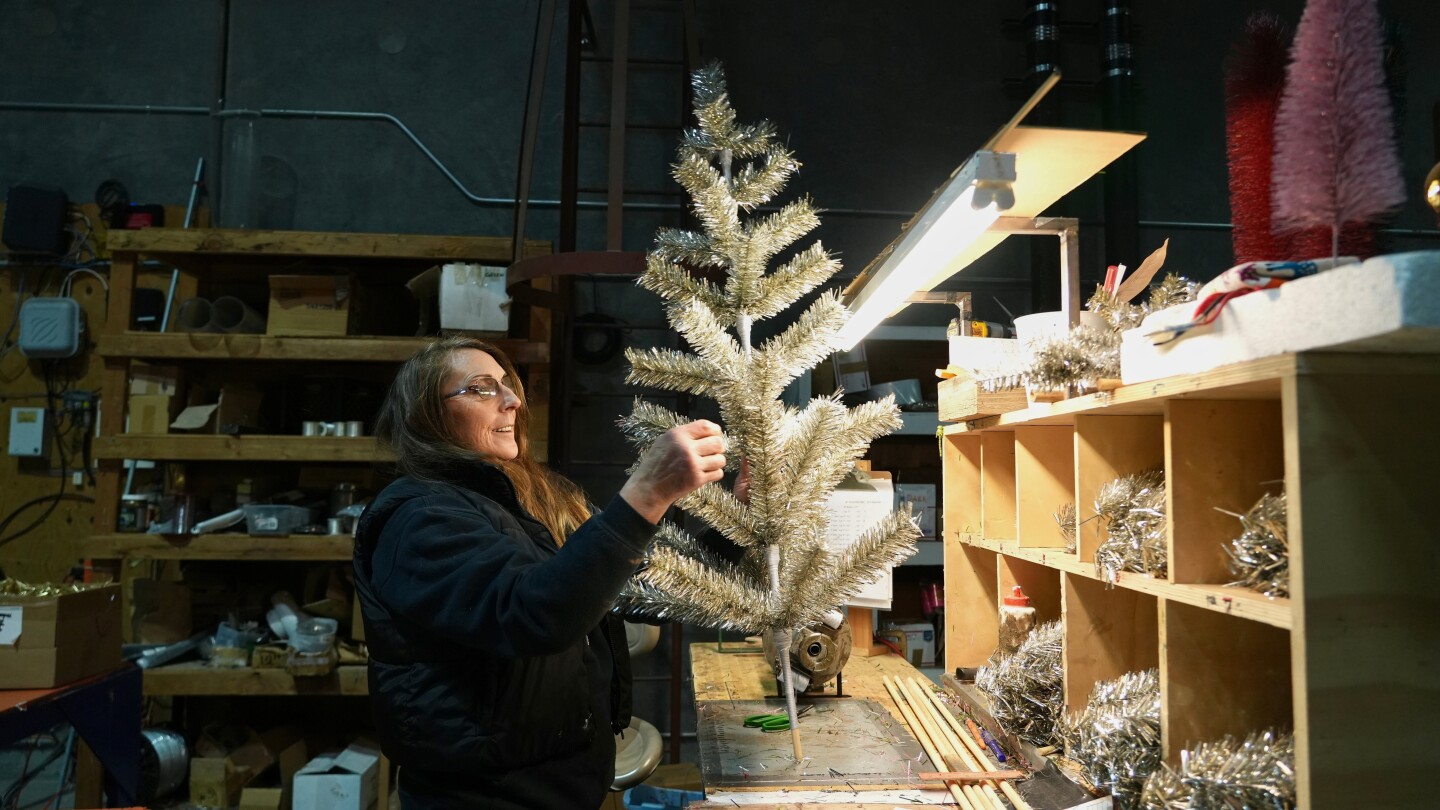
In a Fairfield, California workshop, Mark Latino oversees the production of Christmas tinsel on vintage machinery—a rare domestic operation in an industry dominated by overseas manufacturing. As CEO of Lee Display, a family business established in 1902, Latino represents a shrinking segment of American-made holiday decorations while navigating the complexities of global trade dynamics.
Recent tariff implementations have illuminated the fragile economics of artificial Christmas tree production, triggering 10-15% price increases according to the American Christmas Tree Association. Despite these cost pressures, industry leaders confirm that large-scale production won’t return to U.S. shores due to fundamental structural challenges.
Chris Butler, CEO of National Tree Co., explains the predicament: ‘Artificial trees require intensive labor and specialized components that simply aren’t manufactured in the United States.’ With over 80% of American households opting for artificial trees—a statistic consistent for 15 years—the industry faces a delicate balance between consumer price sensitivity and production realities.
The migration of tree manufacturing began in the 1990s, first to Thailand and subsequently to China, where 90% of global production now occurs. The process remains remarkably hands-on, requiring 1-2 hours per tree for needle molding, branch assembly, and light attachment—tasks performed by workers earning $1.50-$2 hourly in China.
Balsam Brands CEO Mac Harman illustrates the cost disparity: ‘Our feasibility study showed an $800 tree would cost $3,000 if manufactured domestically.’ The company couldn’t even source American-made gloves for fluffing branches, highlighting the depth of the supply chain challenge.
While some companies are diversifying production to Cambodia, tariffs have followed this migration too—with rates fluctuating between 19-49%. The industry response has included workforce reductions, price increases, and operational cutbacks. Harman reports U.S. sales declines of 5-10% despite growth in international markets, suggesting tariffs have dampened domestic demand.
For small operators like Lee Display, which produces approximately 10,000 trees annually alongside commercial displays, the tariffs still impact imported components like lights. Yet Latino values the control domestic production provides: ‘Everything here is either my fault or my careful planning.’
As Butler summarizes the consumer mindset: ‘Putting a ‘Made in the U.S.A.’ sticker on the box won’t do any good if it’s twice as expensive. If it’s 20% more expensive, it won’t sell.’ This reality ensures that despite tariff pressures, America’s Christmas trees will continue bearing international origins for the foreseeable future.