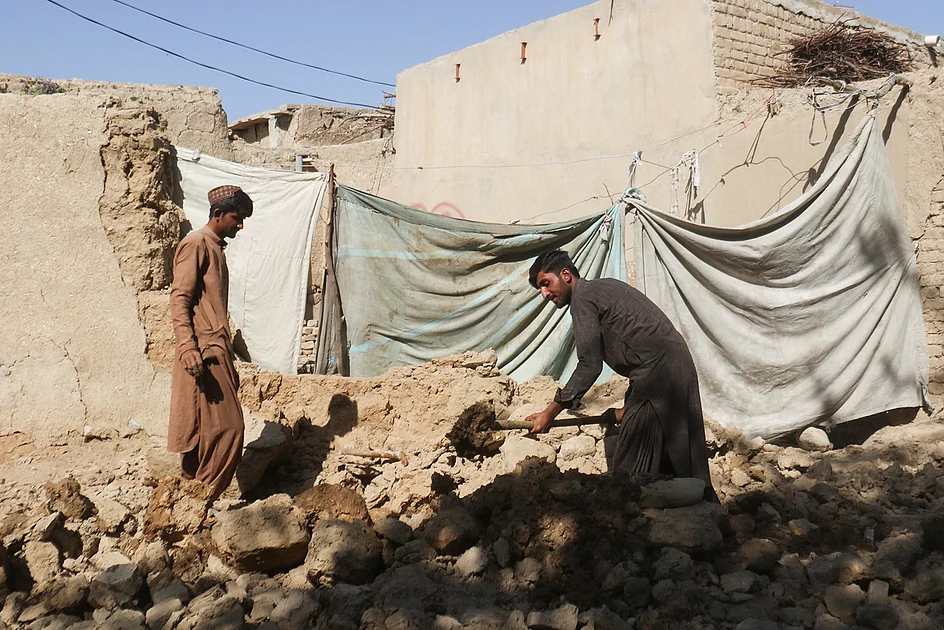
Pakistan’s seismic vulnerability was underscored once again in the early hours of Tuesday when a 4.8-magnitude earthquake struck the region, marking the fifth such tremor recorded within the country’s borders in less than thirty days. According to precise data released by India’s National Centre for Seismology (NCS), the latest event occurred at 1:21 AM IST with its epicenter positioned at coordinates 25.48 degrees North and 66.69 degrees East. A critically important detail noted by seismologists was the earthquake’s exceptionally shallow depth of just 10 kilometers, a characteristic that significantly amplifies ground shaking and elevates potential risks to infrastructure and populations.
This recent seismic activity forms part of a concerning pattern of earth movements throughout November and December 2025. Preceding events include a 3.6-magnitude quake on December 5th at 40 kilometers depth, a 4.3-magnitude tremor on November 25th at 120 kilometers depth, and a more substantial 5.2-magnitude event on November 21st occurring 135 kilometers beneath the surface. Particularly noteworthy was a November 20th earthquake measuring 3.9 in magnitude that similarly featured a shallow 10-kilometer depth, raising concerns among geologists about potential aftershock sequences and continued instability.
Pakistan’s heightened susceptibility to seismic events stems from its unique geological positioning astride the volatile convergence zone where the massive Indian and Eurasian tectonic plates collide. This tectonic boundary creates enormous pressure that regularly releases through earthquakes, with regions including Balochistan, Khyber Pakhtunkhwa, and Gilgit-Baltistan experiencing particular vulnerability due to their proximity to major fault lines. Even the provinces of Punjab and Sindh, situated along the northwestern periphery of the Indian Plate, remain subject to significant seismic risk despite their distance from the primary collision zone.
The National Centre for Seismology has actively disseminated information through its official social media channels and dedicated mobile applications, providing both real-time alerts and educational resources to help communities better understand and prepare for seismic hazards. This ongoing communication effort reflects growing regional recognition of the persistent earthquake threat facing the South Asian subcontinent.