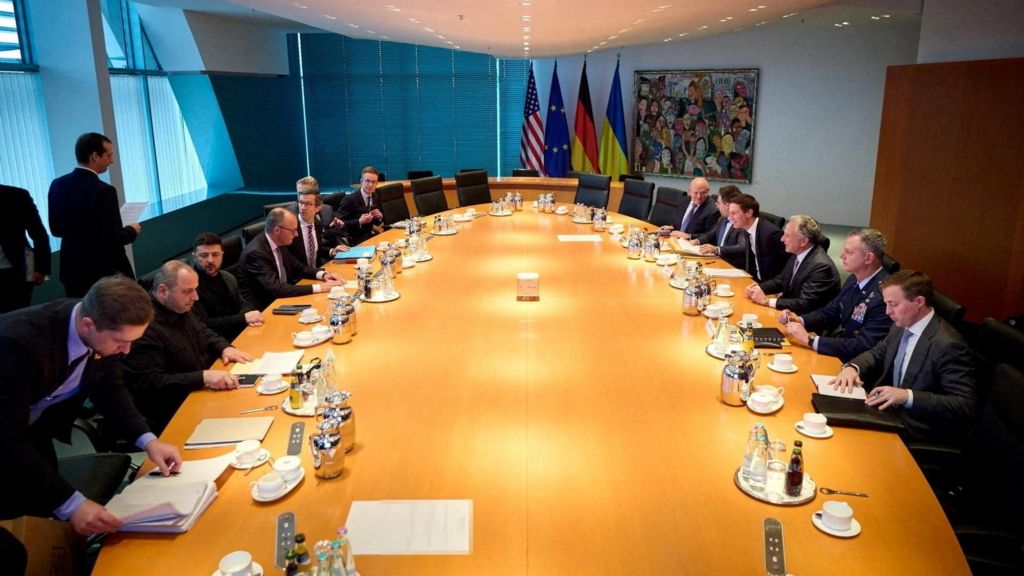
BERLIN – Critical peace negotiations between Ukrainian and American delegations extended into a second day in Germany’s capital on Monday, following intensive five-hour discussions on Sunday that included German Chancellor Friedrich Merz and notable U.S. figures.
The high-stakes diplomatic engagement marked the first face-to-face meeting between President Volodymyr Zelensky and U.S. envoy Steve Witkoff, who has previously engaged with Russian President Vladimir Putin in Moscow. The American delegation also included Jared Kushner, son-in-law of former President Donald Trump, while military representation came from NATO Supreme Allied Commander Europe General Alexus Grynkewich.
In a significant strategic shift, Zelensky indicated readiness to abandon Ukraine’s NATO membership aspirations in exchange for robust security guarantees modeled after NATO’s Article 5 mutual protection clause. ‘This is already a compromise on our part,’ Zelensky stated, acknowledging opposition from ‘some partners from the US and Europe’ regarding NATO accession.
The talks center on a 20-point peace proposal submitted by Ukraine to counter an initial American plan perceived as disproportionately favoring Russian interests. While details remain confidential, Zelensky characterized the points as a ‘foundation’ for reconstruction and security arrangements.
The Donbas region’s status emerged as another critical negotiation point, with Zelensky expressing openness to freezing conflict along current frontlines but insisting any withdrawal arrangement must be symmetrical. ‘For it to be fair, Russia would have to withdraw the same distance,’ he emphasized, describing the matter as ‘extremely sensitive and heated.’
The negotiations occur amid deteriorating humanitarian conditions in Ukraine, where over one million households suffered power outages following Russian attacks on energy infrastructure. Meanwhile, EU members prepare to vote on transferring €90 billion in frozen Russian assets to support Ukraine’s economy, though legal and diplomatic challenges persist with countries like Belgium and Italy expressing reservations.
EU foreign policy chief Kaja Kallas acknowledged the ‘increasingly difficult’ discussions but affirmed continued efforts toward resolution. The Kremlin stated it expects to receive the negotiated concept from U.S. officials, maintaining that Ukraine’s NATO membership remains an absolute ‘red line.’