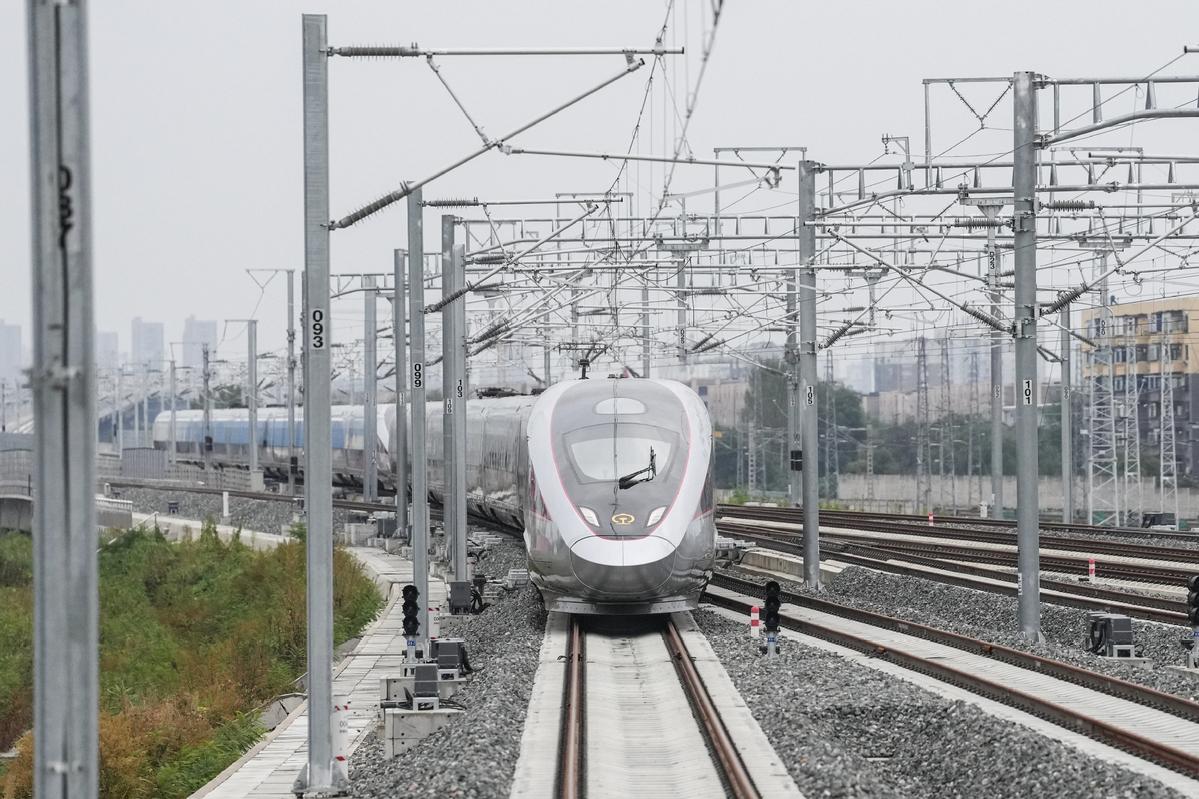
China’s high-speed rail sector is achieving unprecedented technological milestones through fully independent innovation, demonstrating world-leading capabilities in both extreme-condition operations and record-breaking velocity. The recently inaugurated Shenyang-Baihe line in northeastern China serves as a showcase for these advancements, featuring specialized rolling stock engineered for frigid environments and intelligent operational systems.
The Fuxing CR400BF-GS Electric Multiple Unit (EMU), specifically designed for extreme cold regions, represents just one facet of China’s rail technology progression. More remarkably, manufacturing processes have achieved extraordinary precision through intelligent production methods. Track slabs for the Shenyang-Baihe line, measuring 5.6 meters by 2.5 meters, now require merely 10 minutes per unit with height variations controlled within microscopic tolerances comparable to a human hair’s thickness.
The most dramatic advancement emerges in speed technology. The CR450 bullet train, currently undergoing intensive pre-service trials, has achieved breathtaking velocity benchmarks: 453 kilometers per hour in single-train testing and a world-record relative passing speed of 896 kilometers per hour. This places China in uncharted territory as no commercial high-speed rail system globally operates above 400 km/h, eliminating existing reference models for such velocities.
Engineering such extreme performance demanded radical aerodynamic solutions. Between 350-400 km/h, resistance increases by 30%, with 95% originating from air drag. The CR450 addresses this through a lengthened streamlined nose, 20-centimeter lowered roofline, and 50-tonne weight reduction collectively achieving 22% drag reduction.
Beyond physical engineering, China has developed sophisticated control systems featuring complete intellectual property ownership. The CTCS-3 ATP and ATO system, independently developed by CRSC Research & Design Institute, enables autonomous inter-station operation, overspeed protection, and precision stopping even in low-visibility conditions.
For western regional development, a new generation train control system integrated with BeiDou satellite navigation combines multiple data sources including satellite positioning, electronic mapping, and speed sensors to enhance positioning accuracy and reliability in challenging environments.
With China’s high-speed network projected to exceed 50,000 kilometers by end-2025, these technological advances position the country at the forefront of developing not just extensive but intelligent, resilient future-ready rail infrastructure.