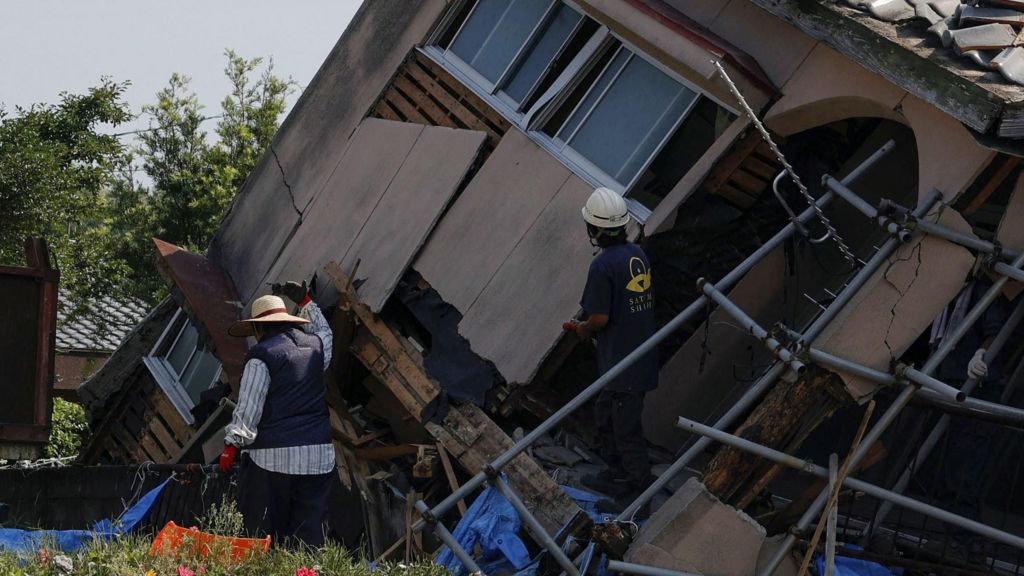
Japanese authorities have escalated warnings about a potential catastrophic earthquake following Monday’s magnitude 7.5 tremor that struck northeastern Japan. This alert marks the second such warning in under two years, reviving concerns about the anticipated ‘big one’—a seismic event projected to occur once every century.
According to Japan’s earthquake investigation panel, there is a 60-90% probability that a megaquake could originate from the Nankai Trough within the next three decades. This seismic zone extends along Japan’s Pacific coastline and has historically generated devastating earthquakes. Officials have projected worst-case scenarios including tsunamis exceeding 20 meters (66 feet) that could inundate Tokyo and surrounding prefectures, potentially resulting in approximately 300,000 fatalities and trillions of dollars in economic devastation.
Residents across seven prefectures—from Hokkaido in the north to Chiba in central Japan—have been instructed to maintain heightened preparedness. While no formal evacuation orders have been issued, authorities are urging citizens to verify evacuation routes, secure household furniture, and assemble emergency supplies including food, water, and portable sanitation facilities.
Government seismologists indicate that there is approximately a 1% chance that Monday’s earthquake could trigger a subsequent magnitude 8.0 or larger event. Takashi Yokota, Japan’s director for disaster management, emphasized during a press briefing that current global seismic data suggests a possibility rather than a prediction of an imminent major tremor.
The Nankai Trough’s seismic history provides sobering context. This subduction zone between Suruga Bay and the Hyuganada Sea has generated catastrophic earthquakes approximately every century, often occurring in pairs. The most recent events in 1944 and 1946 resulted in significant destruction, while the 1707 rupture along the trough’s entire 600-kilometer length triggered Japan’s second-largest recorded earthquake and subsequent Mount Fuji eruption.
Seismological experts remain divided on prediction capabilities. Geologists Kyle Bradley and Judith Hubbard describe the Nankai Trough’s historical pattern as ‘convincingly scary,’ while University of Tokyo Professor Emeritus Robert Geller maintains that earthquake warnings have ‘almost nothing to do with science,’ noting that only about 5% of earthquakes are preceded by detectable foreshocks.
Japan’s current warning system, developed after the catastrophic 2011 magnitude 9.0 earthquake that killed over 18,000 people, was first implemented in August 2024. The Japan Meteorological Agency continues to balance public awareness with caution, stating that while earthquake probability is elevated, ‘this is not an indication that a major earthquake will definitely occur.’