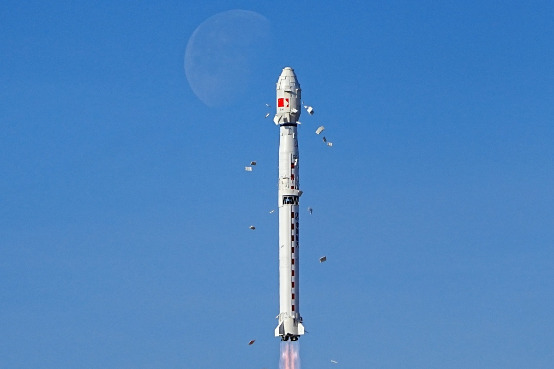
China has successfully deployed the Yaogan-47 remote-sensing satellite into orbit, marking another milestone in its expanding space capabilities. The spacecraft was carried aloft by a Long March 4B rocket that launched at 11:41 a.m. on Tuesday, December 9, 2025, from the Jiuquan Space Launch Center in Inner Mongolia.
The China Aerospace Science and Technology Corporation (CASC), the state-owned enterprise overseeing the mission, confirmed that the satellite reached its intended orbital parameters as planned. The Yaogan-47 represents the latest addition to China’s primary series of Earth observation satellites, designed and manufactured by the China Academy of Space Technology.
This advanced satellite will perform comprehensive monitoring functions including land resource surveys, urban mapping operations, agricultural yield assessment, and environmental protection initiatives. Additionally, it will contribute to disaster prevention and mitigation efforts through its sophisticated sensing capabilities.
Remote-sensing technology operates by detecting and measuring reflected and emitted radiation from terrestrial and marine surfaces, enabling detailed analysis of physical characteristics across the planet. Data collected by the Yaogan constellation has become integral to both governmental decision-making and commercial applications throughout China.
The launch vehicle, developed by the Shanghai Academy of Spaceflight Technology, demonstrates significant payload capacity—capable of delivering multiple satellites with a combined mass of 2.5 metric tons to sun-synchronous orbits approximately 700 kilometers above Earth.
This mission constitutes China’s 82nd space endeavor of the year and the 614th overall deployment of a Long March rocket series, underscoring the nation’s sustained commitment to space exploration and technological advancement.