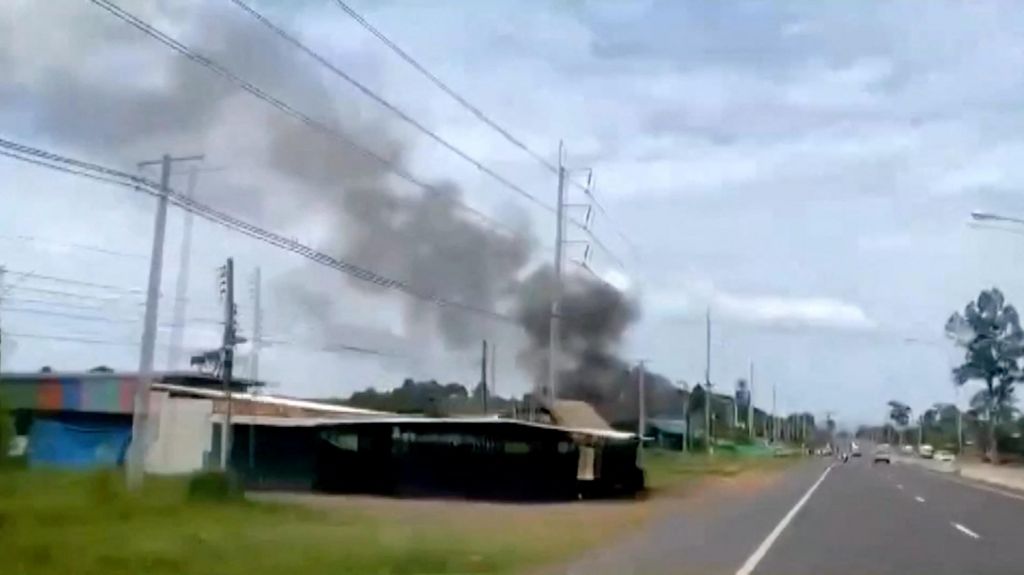
The fragile peace agreement brokered by former US President Donald Trump between Thailand and Cambodia has completely unraveled, triggering the most severe military confrontation along their disputed border since July. The renewed violence has resulted in significant casualties, with at least three Thai soldiers and seven Cambodian civilians confirmed dead since hostilities reignited on Monday.
This latest escalation represents a dramatic breakdown of the Kuala Lumpur peace accord signed in October under Trump’s mediation. Thailand suspended the agreement just two weeks after its signing, and by December, full-scale fighting had resumed. Both nations have exchanged contradictory accounts of how the violence originated, with each accusing the other of initiating hostilities.
Thailand’s military command reported that their forces responded to Cambodian gunfire in Ubon Ratchathani Province that killed a Thai soldier, subsequently launching airstrikes against military targets along the contested frontier. Conversely, Cambodia’s defense ministry maintains that Thai forces attacked first in Preah Vihear province, claiming they exercised restraint by not retaliating initially.
The conflict escalated further when Thailand accused Cambodia of deploying multiple-launch rocket systems, bomb-dropping drones, and kamikaze drones against Thai positions, with some projectiles allegedly striking civilian areas. Cambodia countered with allegations that Thailand fired indiscriminately into civilian zones in Pursat Province.
This border dispute has historical roots stretching back over a century to when French colonial authorities demarcated the boundaries between the two nations. Tensions dramatically intensified in 2008 when Cambodia sought UNESCO World Heritage status for an 11th-century temple located in the contested territory. The current crisis began escalating in May when a Cambodian soldier was killed, plunging bilateral relations to their lowest point in over a decade.
Prior to the July clashes, both nations had implemented reciprocal border restrictions, with Cambodia banning Thai agricultural imports and cutting off power and internet services. Both countries had also been reinforcing their military presence along the border in recent weeks.
The October peace agreement had stipulated the withdrawal of heavy weapons from the disputed region and establishment of an interim observer team. The next phase was supposed to include the release of 18 Cambodian soldiers detained in Thailand. With the ceasefire now collapsed, the future of these diplomatic arrangements remains uncertain.
International travel advisories have been updated, with the British Foreign Office currently recommending against all but essential travel within 50 kilometers of the entire Thailand-Cambodia border region.