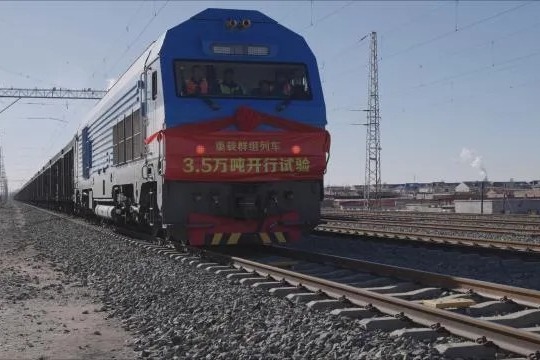
In a landmark achievement for rail transport technology, China has successfully conducted the world’s first test of multiple heavy-haul freight trains operating in synchronized formation using exclusively wireless control systems. This revolutionary trial occurred on December 9, 2025, along the Baoshen Railway in Inner Mongolia Autonomous Region—a critical freight corridor dedicated primarily to coal transportation from the energy-rich Ordos basin.
The breakthrough demonstration involved seven separate freight trains, each weighing 5,000 metric tons, collectively moving 35,000 tons of cargo without traditional physical couplings. Instead, the convoy relied on an advanced intelligent control system developed domestically by China Shenhua (a subsidiary of China Energy Investment Corporation) in collaboration with research partners. The technology utilizes sophisticated wireless communication protocols and real-time algorithmic coordination to ensure perfect synchronization during acceleration and braking maneuvers.
This technological advancement addresses the significant engineering challenge of maintaining precise coordination among multiple heavy trains on a single track, eliminating collision risks while preventing undesirable separation. Traditionally, freight operations have relied on single-train configurations or physically connected cars, limiting capacity and efficiency.
The successful implementation of wireless train formation control promises to transform freight rail economics. Existing rail infrastructure can now achieve over 50% increased transport capacity without requiring new construction, offering a highly cost-effective solution for bulk commodity transportation. This development holds particular significance for China’s energy logistics, enabling more efficient movement of coal from production regions to consumption centers.
Beyond domestic applications, this breakthrough establishes a new technical paradigm for global freight rail systems seeking enhanced safety and operational efficiency in long-distance heavy haul operations. The technology demonstrates how digital innovation can dramatically improve the performance of traditional industrial infrastructure.