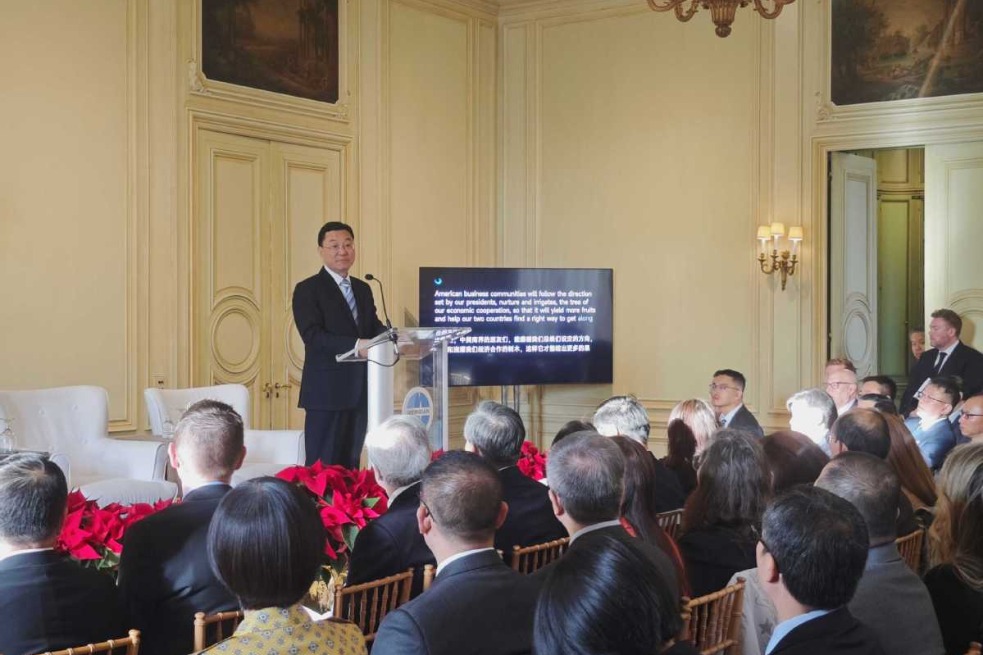
Senior officials and corporate leaders from the world’s two largest economies are spearheading a concerted push to revitalize commercial ties through enhanced dialogue and collaborative ventures. This development emerges against a backdrop of stabilizing diplomatic relations and China’s forthcoming economic planning cycle.
At the China-US Business Cooperation Forum in Washington on December 4th, Chinese Ambassador Xie Feng emphasized the business community’s pivotal role in transcending political differences and capitalizing on opportunities generated by head-of-state diplomacy. The event, jointly organized by the China Council for the Promotion of International Trade and Washington’s Meridian International Center, brought together executives seeking clarity on navigating the relationship’s ‘new era’.
Ambassador Xie highlighted how presidential commitments from both nations have injected ‘precious certainty’ into economic cooperation, with head-of-state diplomacy expected to remain the anchor of bilateral relations. He outlined substantial opportunities arising from China’s pursuit of high-quality development under the 15th Five-Year Plan (2026-2030), particularly with China hosting the 2026 APEC Economic Leaders’ Meeting and the US convening the G20 Summit.
Concurrently on the West Coast, the ‘Port of Opportunity: US-China Business Exchange Breakfast’ in Berkeley, California facilitated connections between 25 Chinese companies and approximately 100 local executives and officials. Discussions spanned finance, agriculture, logistics, aviation, healthcare, renewable energy, and cultural industries.
Ren Hongbin, Chairman of the China Council for the Promotion of International Trade, noted that recent high-level interactions have reinvigorated business confidence, urging concrete implementation of leadership consensus. Oakland Mayor Barbara Lee emphasized China’s significance as the port’s largest import partner (29% of total trade volume), advocating for sustained economic focus despite geopolitical challenges, particularly in green economy initiatives.
John Grubb, Interim President and CEO of the Bay Area Council, highlighted California’s substantial role in US-China trade (approximately 25% of total), emphasizing the importance of maintaining commercial bridges through changing circumstances. The San Francisco Bay Area’s innovation ecosystem, home to companies like Apple, Intel and Nvidia that have significantly benefited from China’s market, was identified as a key driver of future cooperation in emerging sectors including renewable energy, biopharmaceuticals, and the low-altitude economy.
Chinese Consul General in San Francisco Zhang Jianmin underscored the reality of economic interdependence in today’s globalized economy, with supply chains accounting for approximately 70% of global trade. He emphasized that innovation cooperation becomes increasingly vital amid global economic headwinds, with China’s vast market and comprehensive industrial system offering complementary advantages to the Bay Area’s innovative capacity.