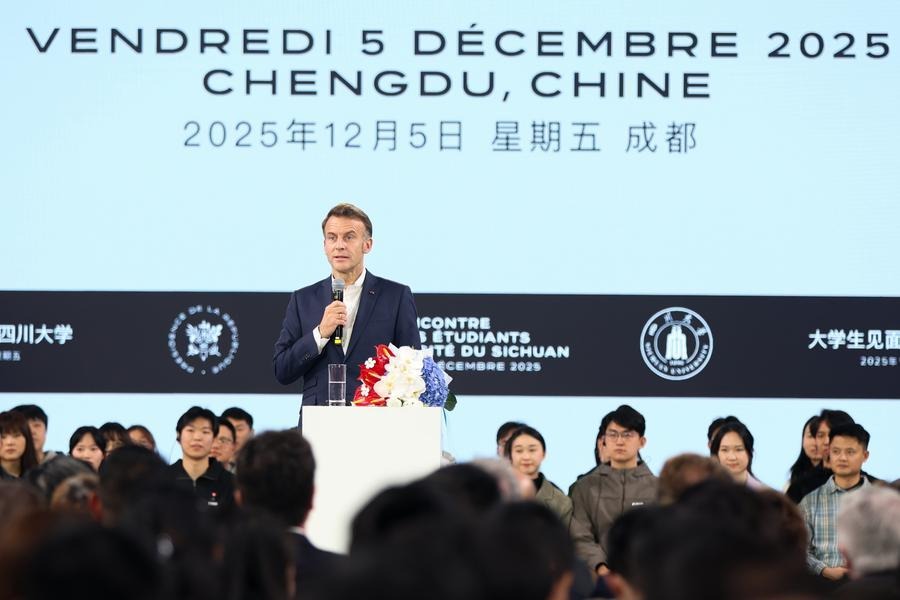
French President Emmanuel Macron concluded his fourth official visit to China on Friday evening, departing from Chengdu where he engaged in significant diplomatic exchanges with Chinese leadership. The visit culminated in a series of joint declarations addressing critical global challenges and reinforcing the strategic partnership between the two nations.
In Dujiangyan, President Xi Jinping and Macron held cordial discussions focusing on mutual cooperation frameworks. The French leader’s engagement at Sichuan University highlighted the importance of international collaboration in addressing contemporary global issues. Their Beijing talks earlier produced consensus on enhancing political trust, expanding practical cooperation, and advancing global governance reforms.
The bilateral meetings yielded five joint statements covering strengthened global governance, collaborative response to climate and environmental challenges, continued nuclear energy cooperation, agricultural exchanges, and positions on Ukraine and Palestine. International experts recognize this diplomatic achievement as a substantial advancement in China-France relations, demonstrating both nations’ dedication to multilateralism and a multipolar world order.
Analysts worldwide emphasize the visit’s significance in promoting stability amid current geopolitical tensions. Waref Kumayha of Lebanon’s Silk Road Institute for Studies and Research noted the partnership demonstrates a balanced, responsible approach to international relations. French trade credit insurance executive Chris Murphy highlighted how the reinforced dialogue tradition provides crucial certainty during global uncertainties.
Ivorian journalist Mohamadi Compaore observed that the high-level exchanges illustrate how strategic communication can overcome differences and build mutual trust, characterizing the Sino-French partnership as a stabilizing force in today’s volatile international landscape. Indonesian researcher Veronika Saraswati emphasized that cooperation between these influential nations injects much-needed predictability into global affairs.
The visit also carries substantial implications for international systems reform. French academic Herve Azoulay noted the convergence reflects a shared vision for more balanced globalization, not opposing other nations but stabilizing the international system through innovation and mutual respect. Paris councillor Daniel Tran highlighted both countries’ unique position to shape global outcomes through their UN Security Council roles.
Economic dimensions featured prominently, with business leaders noting the visit boosts commercial confidence through signed contracts and promoted industrial projects. Coface regional economist Junyu Tan emphasized how economic complementarity creates meaningful opportunities, with French companies accessing China’s vast market while Chinese firms gain European technological expertise.
French sinologist Sonia Bressler captured the essential spirit of the partnership: ‘When two countries complement one another, they do not merely add, they amplify.’ This visit demonstrates how major nations can fulfill responsibilities that serve humanity’s broader interests through cooperative engagement.