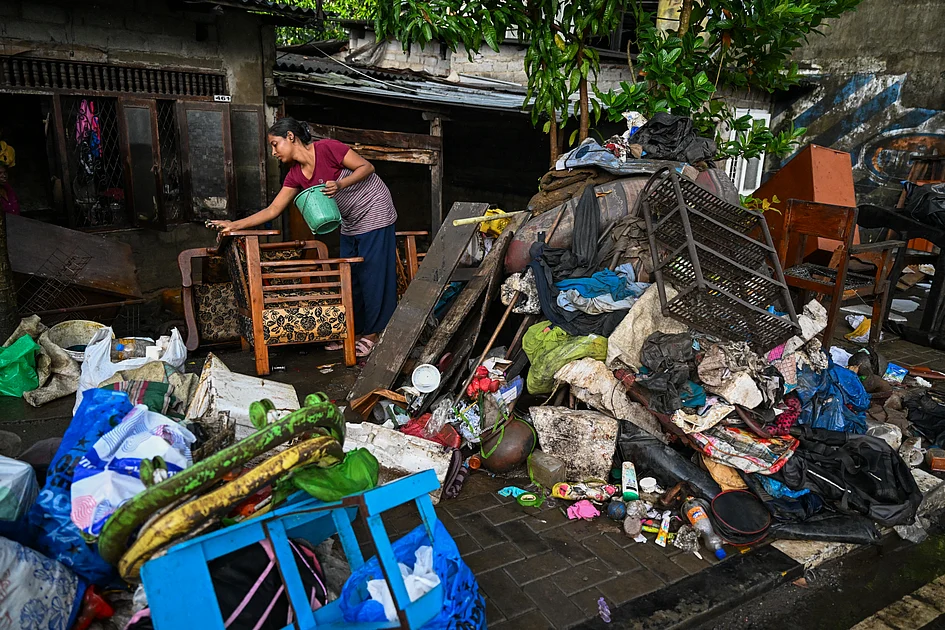
Sri Lankan authorities escalated landslide alerts on Sunday as torrential rains continued to batter regions already crippled by Cyclone Ditwah, with the official death count climbing to 618 casualties. The catastrophic weather system has impacted over two million residents—representing nearly ten percent of the nation’s population—through devastating floods and landslides marking the most severe natural disaster this century.
The Disaster Management Centre (DMC) reported that ongoing monsoon conditions are exacerbating the situation, saturating hillsides and increasing instability across central mountainous zones and northwestern midlands. Aviation units are conducting critical supply missions to isolated communities in the country’s interior, where landslide debris has severed access routes.
International assistance continues to arrive, with the Sri Lanka Air Force receiving a humanitarian shipment from Myanmar on Sunday. Official statistics reveal 209 individuals remain missing, while the number of displaced persons in government shelters has decreased to 100,000 from a peak of 225,000 as floodwaters gradually recede.
Structural damage assessment indicates over 75,000 homes suffered impairment, including approximately 5,000 completely destroyed properties. In response, the government unveiled a comprehensive compensation initiative on Friday to facilitate reconstruction of residences and revitalization of businesses devastated by the calamity.
Financial support measures include offers of up to 10 million rupees ($33,000) for survivors to acquire safer land and construct new dwellings, alongside one million rupees compensation for families of deceased or permanently disabled victims. The central bank has mandated commercial lenders to restructure outstanding loans amid recovery efforts.
The disaster strikes as Sri Lanka demonstrates fragile economic recovery from its 2022 financial collapse. President Anura Kumara Dissanayake acknowledged to parliament that while economic indicators had improved, the nation lacks sufficient resilience to independently manage reconstruction costs potentially reaching $7 billion. The International Monetary Fund is evaluating Sri Lanka’s request for an additional $200 million in emergency funding beyond its existing $2.9 billion bailout program.