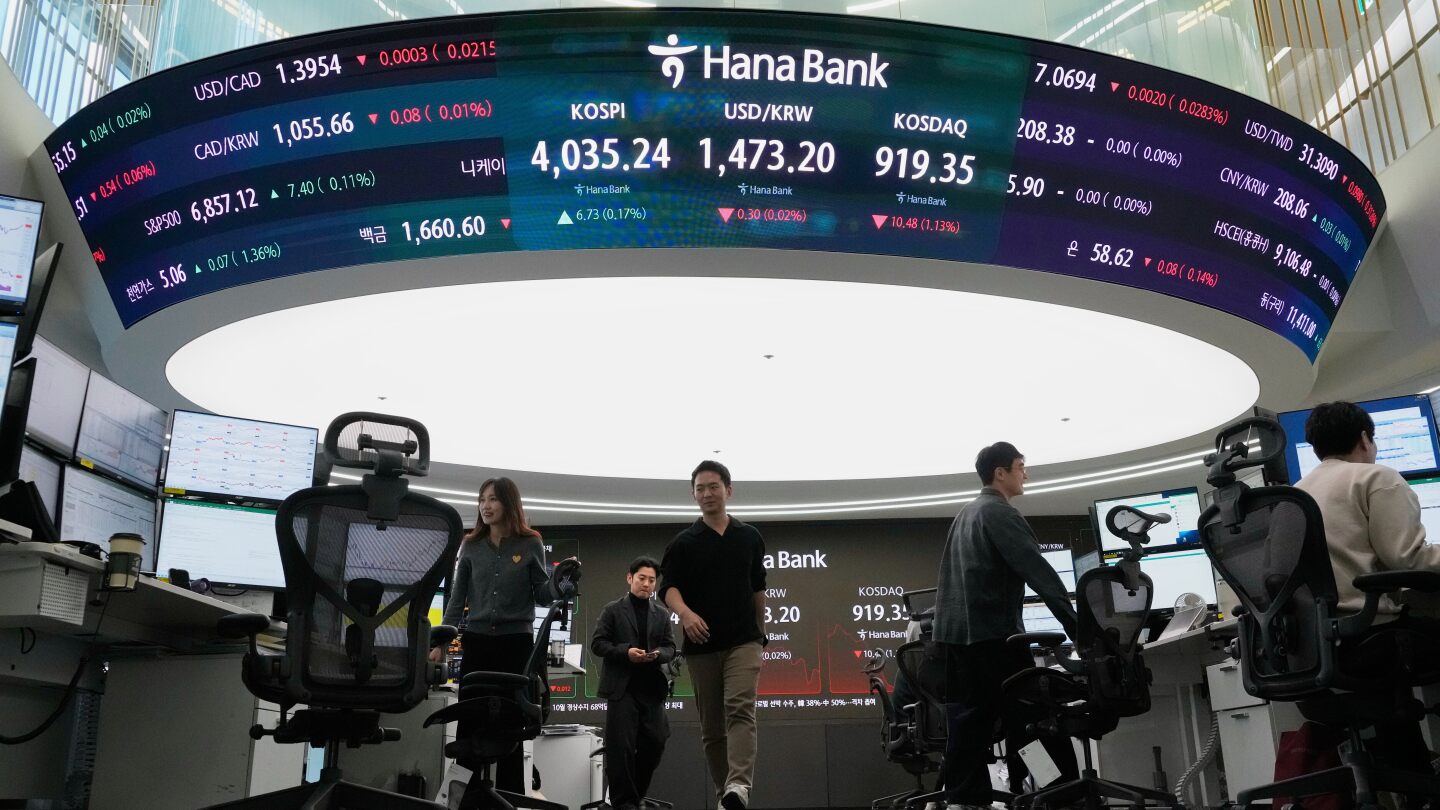
Financial markets across Asia exhibited divergent trends on Friday as investors adopted a cautious stance ahead of critical economic data releases and central bank policy decisions. The trading session reflected growing uncertainty about monetary policy directions in both the United States and China.
Japan’s Nikkei 225 index retreated significantly, dropping 1.2% to close at 50,408.70, partially reversing previous gains. This decline coincided with disappointing economic data showing household spending decreased by 3.0% year-on-year in October—the most substantial contraction since January 2024 and contrary to market expectations of modest growth. Technology stocks led the downturn, with chip testing equipment manufacturer Advantest Corp. falling nearly 2.3% and semiconductor producer Tokyo Electron declining 2.8%.
Chinese markets presented a mixed picture as traders awaited key economic indicators scheduled for release next week, including inflation figures, trade data, and producer price indices. Hong Kong’s Hang Seng index slipped 0.1% to 25,921.69, while mainland China’s Shanghai Composite index gained 0.1% to reach 3,877.83. Market participants also anticipated policy signals from upcoming high-level economic meetings in China.
South Korea’s Kospi index outperformed regional peers, climbing 1.1% to 4,074.00, driven by substantial gains in major corporations. LG Electronics surged 5.6%, while Hyundai Motors advanced 7.2%. Australia’s S&P/ASX200 registered minimal movement, edging up less than 0.1% to 8,623.40, and Taiwan’s Taiex remained nearly unchanged.
India’s Sensex index posted modest gains, rising 0.1% after the Reserve Bank of India reduced its repo rate to 5.25% from 5.5%, citing weak price pressures and anticipated economic slowdown. This monetary easing contrasted with growing uncertainty about the Federal Reserve’s interest rate trajectory.
The cautious Asian trading session followed a relatively stable performance on Wall Street, where the S&P 500 added 0.1% to reach 6,857.12—positioning it just 0.5% below its all-time high. The Dow Jones Industrial Average dipped slightly by 0.1% to 47,850.94, while the Nasdaq composite rose 0.2% to 23,505.14. Retail giant Dollar General surged 14% after reporting better-than-expected quarterly profits, demonstrating improved customer traffic and enhanced profit margins.
Market sentiment remained influenced by concerns about potential overinvestment in artificial intelligence sectors and ongoing uncertainty regarding Federal Reserve policy. Recent labor market data showing fewer unemployment claims and reduced layoffs suggested stronger job market conditions than anticipated, potentially reducing the urgency for immediate interest rate cuts.
In commodity markets, U.S. benchmark crude declined by 17 cents to $59.50 per barrel, while Brent crude, the international standard, slipped 11 cents to $63.15 per barrel. Currency markets saw the U.S. dollar weaken to 154.77 Japanese yen from 155.12 yen, while the euro strengthened slightly to $1.1657 from $1.1645.