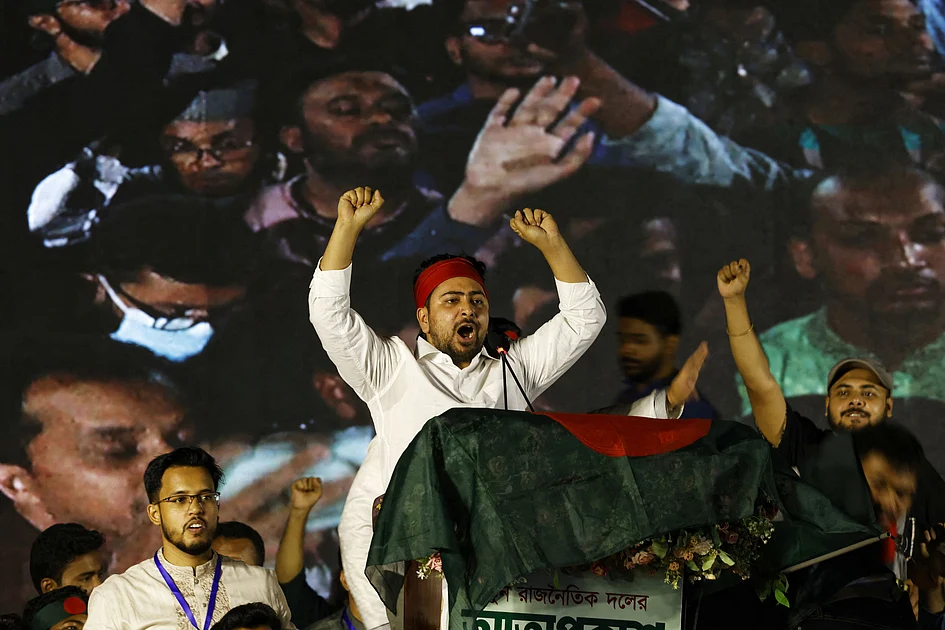
Bangladesh’s nascent National Citizen Party (NCP), born from a massive student-led uprising that toppled long-serving Prime Minister Sheikh Hasina, now confronts the formidable challenge of transforming street activism into parliamentary representation. With February elections approaching, the party finds itself trailing established political forces despite initial widespread enthusiasm.
Recent polling data from the U.S.-based International Republican Institute reveals the NCP securing merely 6% support, placing it behind both the Bangladesh Nationalist Party (BNP) at 30% and the hardline Jamaat-e-Islami at 26%. This disappointing standing highlights the difficulties faced by a movement attempting to break decades of two-party dominance despite its revolutionary origins.
The party’s 27-year-old leader, Nahid Islam, acknowledges organizational deficiencies: ‘Our structure remains underdeveloped due to insufficient time for establishment.’ Operating from a graffiti-adorned office in Dhaka’s high-rise district, the NCP confronts well-entrenched rivals with extensive networks reaching deep into rural constituencies.
Multiple challenges hamper the party’s progress: ambiguous positioning on critical issues including women’s and minority rights, limited financial resources dependent on crowdfunding and small donations, and allegations of corruption that contradict its proclaimed zero-tolerance policy. The party’s poor showing in September’s Dhaka University student elections—failing to secure any seats—further demonstrates waning support at the institution that originally fueled the anti-Hasina movement.
In response to these obstacles, the NCP has initiated discussions with established parties including BNP and Jamaat-e-Islami regarding potential alliances. While such partnerships might improve electoral prospects, analysts warn they could undermine the party’s distinctive identity as an alternative to traditional politics.
Despite these challenges, the party maintains innovative approaches to political engagement. Its unconventional candidate selection process interviewed over 1,000 ordinary citizens nationwide, including a rickshaw puller who took unpaid leave to participate and a student partially blinded by police during earlier protests.
The movement continues to attract idealistic supporters like Dr. Tasnim Jara, who abandoned a promising medical career in Cambridge to contribute to building a more inclusive political system. As BNP leader Mirza Fakhrul Islam Alamgir noted: ‘Young people will dominate future politics, making their parliamentary inclusion beneficial.’
The NCP’s journey represents a fundamental test of whether youth-driven movements can successfully transition from protest politics to sustainable governance in Bangladesh’s complex political landscape.