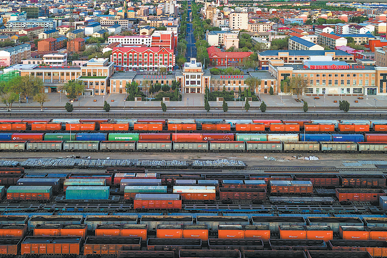
The Ereenhot Railway Port, a crucial border crossing in China’s Inner Mongolia Autonomous Region, is poised for significant expansion following a historic trade achievement. By November 20, 2025, the port had processed an unprecedented 3,500 China-Europe freight train journeys, marking the highest volume since the service’s inception in 2013.
This milestone was celebrated with the departure of a Russia-bound train carrying 55 containers, highlighting the port’s growing importance in Eurasian trade networks. According to Yang Dongdong, the port’s technical manager, the facility has consistently handled over 3,000 China-Europe freight trains annually for three consecutive years, demonstrating sustained growth in cross-continental rail commerce.
The port’s expansion strategy includes launching new routes to Russian cities later this year and accelerating construction of the second-line project between Ereenhot and Mongolia’s Zamiin-Uud Station. This infrastructure development aims to support increasing trade flows along the Belt and Road Initiative’s central corridor, where Ereenhot serves as the exclusive border crossing.
Route connectivity has dramatically expanded from just two paths in 2013 to 74 currently active routes, linking Chinese manufacturing hubs with over 70 logistics centers across more than 10 European nations, including Germany and Poland. Recent additions include routes from Wuhu (Anhui province) and Datong (Shanxi province) to various Russian destinations, creating a denser transportation network.
A notable development has been the improvement in return freight efficiency, with 1,760 return trains recorded—representing 50.3% of total operations and a 28.7% year-on-year increase. Trade composition remains stable, with exports dominated by automobiles, electronics, home appliances, and general merchandise, while imports primarily consist of timber and paper products.
The port has implemented significant operational enhancements through digital transformation, including paperless customs clearance and improved coordination with Mongolian counterparts. The ‘two-station integration’ model with Zamiin-Uud Station facilitates real-time information sharing on train flows and inventory management, while optimized inspection processes have reduced customs clearance time by over 5% year-on-year.
Local businesses report substantial benefits from the rail network’s growth. Meng Xiangyu, a freight company manager, noted that since 2018, the service has provided “a cheaper, more efficient and safe way to transport goods,” enabling expansion of both domestic and international client networks.
Looking forward, port authorities plan to leverage capacity expansion and efficiency improvements to achieve year-on-year growth in throughput while ensuring smooth operation of international rail transport corridors, further solidifying China’s role in transcontinental trade.