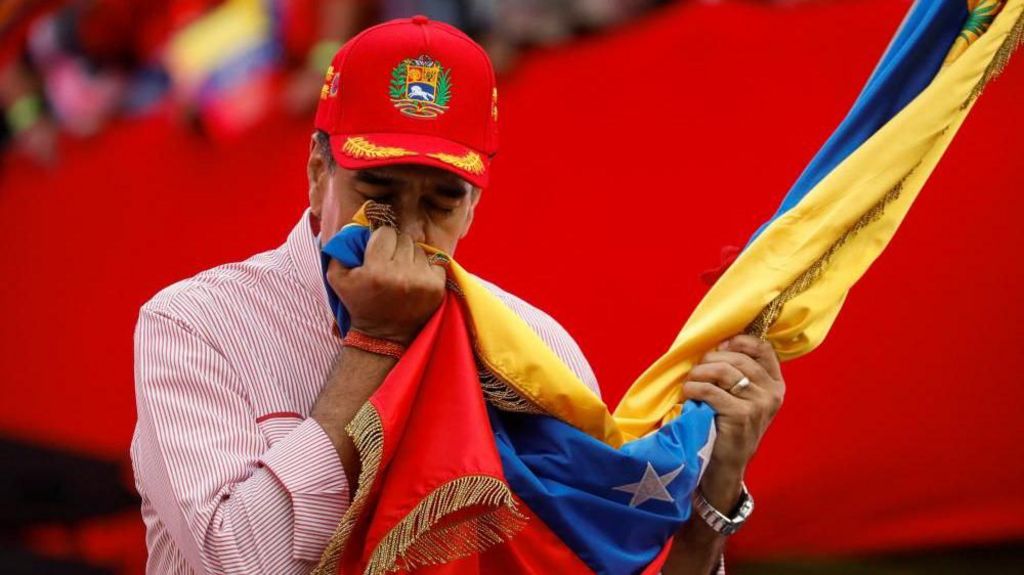
The Trump administration has significantly intensified its campaign against Venezuelan President Nicolás Maduro through military, diplomatic, and economic measures. In recent developments, the United States has doubled the monetary reward for information leading to Maduro’s capture while deploying substantial naval assets to the Caribbean region.
This strategic military mobilization represents the largest U.S. force presence in the area since the 1989 invasion of Panama. The deployment includes 15,000 troops, aircraft carriers, guided-missile destroyers, and amphibious assault ships. Officially designated as a counter-narcotics operation, the mission has already conducted more than 20 strikes on vessels suspected of drug trafficking in international waters, resulting in over 80 casualties.
The administration has characterized these actions as part of a ‘non-international armed conflict’ with drug traffickers, labeling targeted individuals as ‘narco-terrorists.’ However, international legal experts have questioned the legality of these strikes, with a former International Criminal Court prosecutor describing the campaign as ‘a planned, systematic attack against civilians during peacetime.’
President Trump has personally engaged with the situation, confirming a November 21st phone conversation with Maduro. While Trump has not disclosed specific details, reports indicate he delivered an ultimatum for Maduro to leave Venezuela within one week. Following the expiration of this deadline, Trump declared the airspace around Venezuela closed to all traffic.
The administration justifies its aggressive stance by citing Venezuela’s role in drug trafficking and migration patterns. Trump has accused Maduro of ’emptying his prisons and insane asylums’ to force migrants toward the U.S., though these claims remain unsubstantiated. Additionally, the U.S. has designated two Venezuelan criminal groups—Tren de Aragua and Cartel de los Soles—as Foreign Terrorist Organizations, with Trump alleging Maduro personally leads the latter.
Maduro has vehemently denied these accusations, countering that the U.S. is using the ‘war on drugs’ as a pretext to orchestrate regime change and gain access to Venezuela’s substantial oil reserves. Meanwhile, regional analysts note that Venezuela primarily serves as a transit country for drugs produced elsewhere, with most cocaine reaching the U.S. via Pacific routes rather than Caribbean channels.
The White House has not ruled out ground operations in Venezuela, with Trump’s press secretary acknowledging that ‘there’s options at the president’s disposal that are on the table.’ Military analysts observe that the current deployment far exceeds what would be necessary for purely counter-narcotics operations, suggesting broader strategic objectives may be underway.