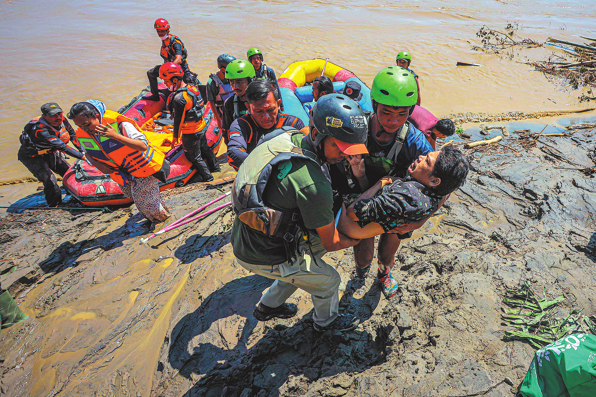
Southeast Asia is grappling with an escalating climate emergency as catastrophic storms and unprecedented flooding displace tens of thousands, compelling regional experts to demand immediate action on adaptation financing. The convergence of climate change and inadequate infrastructure has created a perfect storm of devastation across vulnerable nations.
Recent meteorological data reveals alarming patterns, with the Association of Southeast Asian Nations Specialized Meteorological Center projecting above-normal rainfall throughout the region until January. This phenomenon is amplified by a persistent negative Indian Ocean Dipole—a critical climate pattern characterized by contrasting sea-surface temperatures that significantly influences regional weather systems.
The human toll has been staggering: Indonesian authorities report over 300 fatalities from Sumatran floods and landslides, while Thailand’s southern provinces mourn 145 lives lost. Malaysian emergency services have evacuated more than 20,000 citizens, and Vietnam contends with 108 casualties from mid-November’s torrential rains that triggered devastating floods and landslides.
Climate experts emphasize that adaptation has become the paramount priority for developing economies. Dr. Sheeba Chenoli, University of Malaya geography associate professor, stresses that while global climate strategies predominantly focus on emission reductions, adaptation requires hyper-localized approaches. “Flood hazard mapping and similar initiatives must be community-based,” she asserts, “because only local populations possess the intimate knowledge of what truly needs implementation.”
The recent UN climate conference in Brazil produced significant commitments, including pledges to double adaptation finance by 2025 and triple it by 2035. However, Dr. Serina Abdul Rahman of the National University of Singapore argues that ASEAN nations should have initiated robust adaptation measures much earlier, criticizing “elitist approaches to knowledge, science and policymaking” that exclude valuable traditional ecological knowledge.
Deforestation emerges as a critical exacerbating factor, with Southeast Asia experiencing the tropics’ fastest forest loss despite containing 15% of the world’s tropical forests. Indonesia alone accounts for over 60% of regional deforestation, dramatically increasing vulnerability to landslides during extreme rainfall events.
Cesar Carlito Baclagon, regional finance campaigner at environmental organization 350.org, frames adaptation as a fundamental survival strategy: “Building resilient, locally grounded systems isn’t merely precautionary—it’s what makes continued existence possible. These communities deserve not just to endure but to thrive.” This perspective underscores the growing consensus that climate action must integrate adaptation and sustainable development, particularly across the Global South where climate impacts are most severe yet resources remain scarcest.