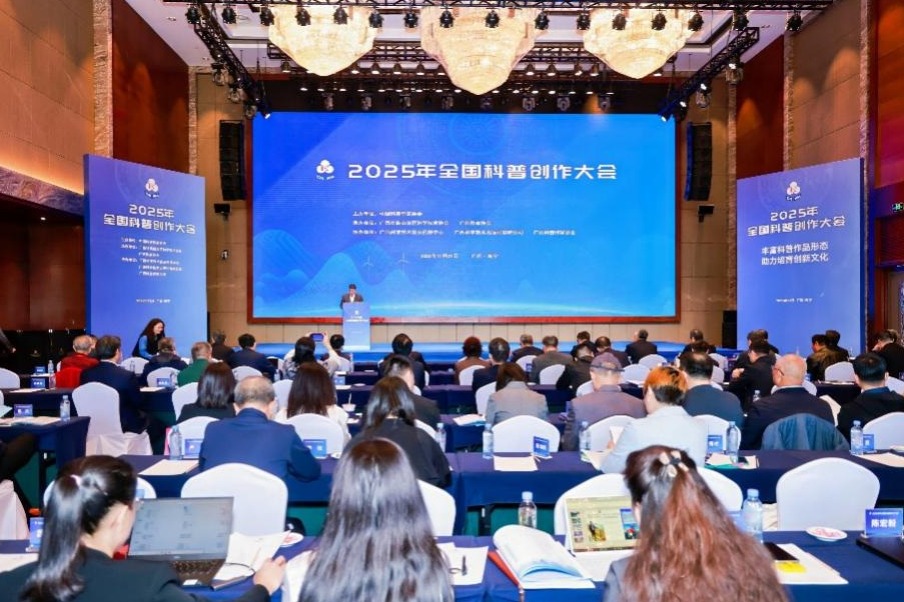
NANNING—At a pivotal gathering of thought leaders, the intersection of technology and art emerged as a powerful catalyst for innovation, with experts advocating for a symbiotic relationship between these traditionally distinct fields. The 2025 National Conference on Science Popularization Content Creation, organized by the China Science Writers Association, became a platform for envisioning how disruptive technologies like artificial intelligence could revolutionize creative expression without supplanting human artistry.
Shu Yong, a member of the National Committee of the Chinese People’s Political Consultative Conference and vice-president of the Kaiming Art Academy, presented a compelling vision of mutual empowerment between science and art. “While technological revolutions have historically sparked artistic revolutions,” he noted, “I equally believe art can propel technological development forward. The humanities offer invaluable perspectives that guide technological advancement with ethical and creative considerations.”
The acclaimed artist, who has incorporated AI into his painting practice for three years, emphasized that his engagement with technology transcends mere production of visually striking works. Instead, he described it as “an exploration of knowledge through continuous creation”—a process that generates timeless classics reflective of their technological era while preserving irreplaceable humanistic elements.
Documentary filmmaker Li Chengcai reinforced this perspective, addressing the critical challenge of translating complex scientific concepts into accessible public understanding. “We must maintain both the solemnity of scientific principles and the engaging storytelling that resonates with general audiences,” Li explained. He characterized this balancing act as navigating an inherent conflict between rigid scientific accuracy and narrative flexibility, where the ultimate goal is discovering “the warmth and humanistic care within science.”
The conference highlighted several successful integrations of technology and art, including this year’s Spring Festival Gala presentation where robots performed the traditional yangko dance—an artistic demonstration of AI’s potential future applications. Such collaborations, experts agreed, make scientific concepts visible, comprehensible, and emotionally perceptible through artistic approaches.
Ultimately, the gathering served as both forecast and foundation: a prediction of inevitable changes brought by disruptive technologies, and a commitment to ensuring these changes enrich rather than diminish human creativity. The China Science Writers Association aims to cultivate an innovative culture through such dialogues, expanding the forms and impact of popular science works in an increasingly technologically-integrated world.